 PDF (Español)
 FLIP
FLIP
Authors

Abstract
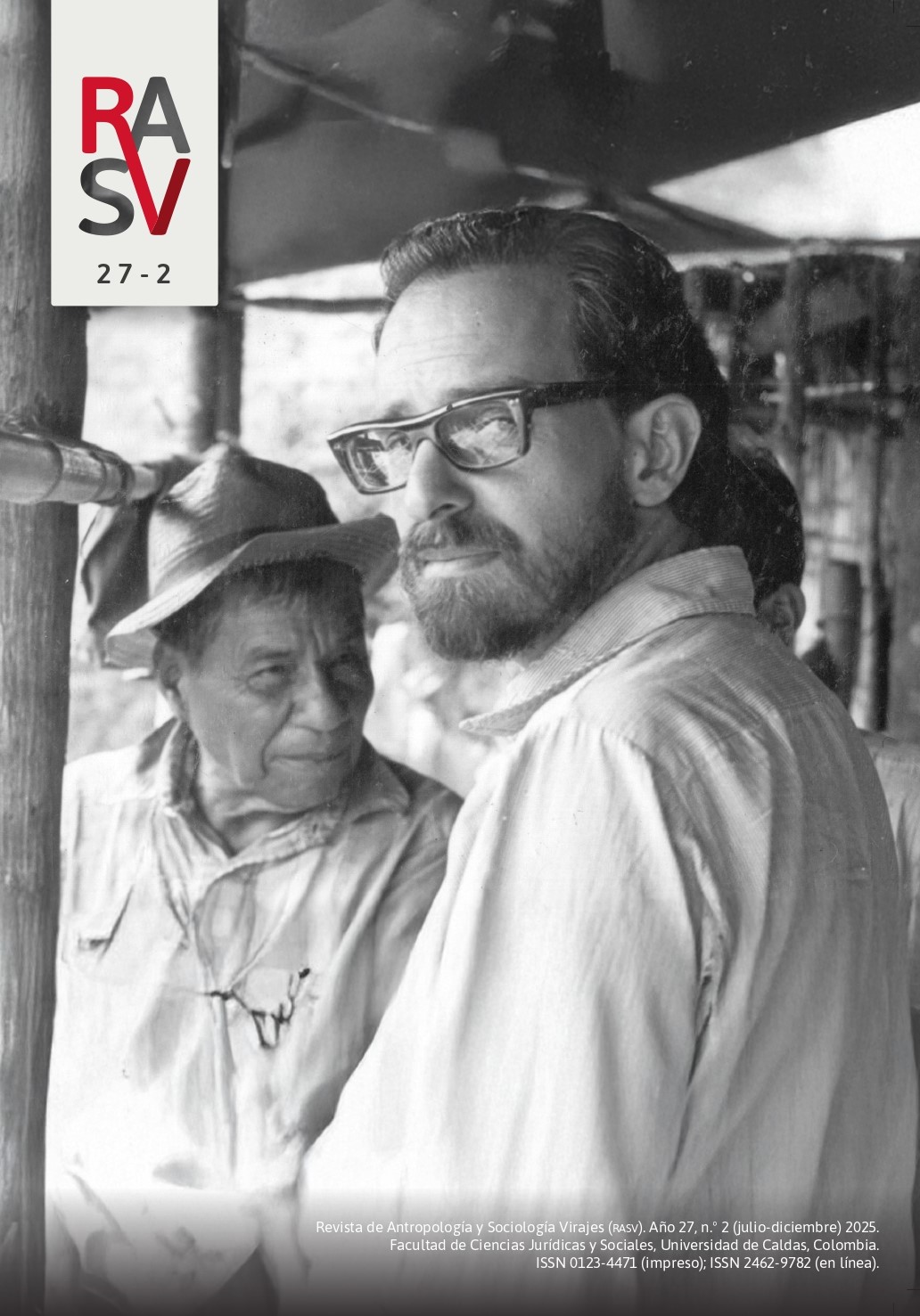
This article examines part of the work of anthropologist Luis Guillermo Vasco, corresponding to his ethnography of the Embera people in Colombia, as a significant contribution to fundamental anthropological debates without the need to insert itself into dominant academic discourses. It then analyzes how Vasco integrated everyday material life, especially pottery and material production, with primordial mythical structures that symbolically sustain Embera culture. Based on his own recent foray into Embera communities in Risaralda and Caldas, the author of the essay identifies recursive and adaptive processes through which Embera culture manages its continuity in the face of significant cultural dissolutions such as the disappearance of pottery and linguistic decline. It is argued that cultural persistence does not lie in the literal preservation of specific elements, but in the strategic capacity for symbolic self-reference to origin and creation, which allows the community to change while remaining the same, thus concluding that Embera culture endures through continuous change and not in spite of it.
Keywords


References
Bartolomé, M. A. (2003). En defensa de la etnografía. El papel contemporáneo de la investigación intercultural. Revista de Antropología social, (12), 199-222.
Bateson, G. (1958). Naven: A survey of the problems suggested by a composite picture of the culture of a New Guinea tribe drawn from three points of view. Stanford University Press.
Bateson, G. (1979). Mental process criteria. En Mind and Nature. A necessary unit (pp. Pp. 89-128). Library of Congress.
Clifford, J. (1983). On Ethnographic Authority. Representations, 2, 118–146. https://doi.org/10.2307/2928386
Brand, S. (1976). For god’s sake, Margaret: conversation with Gregory Bateson and Margaret
Mead. CoEvolution Quarterly, 10(21), 32-44.
Clifford, J. (1990). Sobre la autoridad etnográfica. En: Reynoso, C. (Comp.). El surgimiento de la antropología posmoderna (C. Reynoso, Trad.) (pp. 141-170). Gedisa.
Csordas, T. (2021). Una mirada retrospectiva y nuevas reflexiones sobre los procesos de embodiment como paradigma y orientación metodológica para la Antropología.Encartes, 07, 337-356. https://doi.org/10.29340/en.v4n7.233
Eglash, R. (1997). Bamana Sand Divination: Recursion in Ethnomathematics. American Anthropologist, 99(1), 112–122. http://www.jstor.org/stable/682137
Eglash, R. (1999). Recursion. En African fractals. Modern computing and indigenous design (pp.109-146). Rutgers University Press.
Encyclopædia Universalis. (s.f). Divinités et cultes (anthropologie). Encyclopædia Universalis. https://www.universalis.fr/classification/sciences-humaines-et-sociales/anthropologie-et-ethnologie/anthropologie-religieuse/divinites-et-cultesanthropologie/
Geertz, C. (1973). Deep play: Notes on the Balinese cockfight. En The Interpretation of Cultures (pp.412-453). Basic books Inc. https://cdn.angkordatabase.asia/libs/docs/cliffordgeertz-the-interpretation-of-cultures.pdf
Jaramillo, P. (2007). Kariburu: digresión ritual y posicionamiento político en el trabajo de curación entre los embera. Universitas Humanística, 63(63). https://revistas.javeriana.edu.co/index.php/univhumanistica/article/view/2339
Llerena García, E y Pernett, M. (2023). Herramientas tecnológicas y didácticas para la conservación de la lengua emberá. Lingüística y Literatura, 44(84), 124-153.
Imbett-Vargas, E. y Monterroza-Ríos, Á. (2018). Análisis de artefactos identitarios de la comunidad Indígena Emberá Katío (Resguardo Jaidukama-Ituango, Antioquia-). El Ágora USB, 18(1), 173-186.
Lévi-Strauss, C. (1968). Mitológicas. Lo crudo y lo cocido. Fondo de Cultura Económica.
Lévy-Bruhl, L. (1963). La mythologie primitive. Le monde mythique des Australiens et des Papous (Nouvelle édition). Presses universitaires de France.
López Caballero, P. (2024). El Estado, el “indio” y el antropólogo. En: Restrepo, E.; Sandoval, P. (Eds.). Nuestras antropologías. Elaboraciones y problemáticas desde América Latina y el Caribe. ICANH-ALA. Pp. 387-396.
Lozano-Rivera, C. (2025). The Embera Category of Jai: A Territorial-Cognitive Analysis. Journal of Ecohumanism, 4(2), 1775-1786. https://doi.org/10.62754/joe.v4i2.6559
Marulanda García, D. (2025). La multiplicación del maíz y la transformación del yerno en mico: indagaciones acerca de un relato embera. Revista de Antropología y Sociología Virajes, 27(1). https://doi.org/10.17151/rasv.2025.27.1.2
Ostrow, J. M. (1990). The availability of difference: Clifford Geertz on problems of ethnographic research and interpretation. International Journal of Qualitative Studies in Education, 3(1), 61–69. https://doi.org/10.1080/0951839900030106
Pardo Rojas, M. (1986). La escalera de cristal: términos y conceptos cosmológicos de los indígenas Emberá. Maguaré, (4).https://revistas.unal.edu.co/index.php/maguare/article/view/21-46
Real Academia Española: Diccionario de la lengua española, 23.ª ed., [versión 23.8 en línea]. https://dle.rae.es> [18-03-2025].
Reynoso, C. (1995). El lado oscuro de la descripción densa. Revista de antropología, 16, 17-43.
Reynoso, C. (2016). Recursividad: El eterno y grácil bucle. En Complejidad y Caos. Una exploración antropológica (pp. 343-350). SB editores.
Runk, J.V. (2001). Wounaan and Emberá use and management of the fiber palm Astrocaryum standleyanum (Arecaceae) for basketry in eastern Panamá. Econ Bot 55, 72–82. https://doi.org/10.1007/BF02864547
Saussure, F. (1945). Lingüística geográfica. En Curso de lingüística general (pp. 305-336). Editorial Losada.
Sherif, B. (2001). The Ambiguity of Boundaries in the Fieldwork Experience: Establishing Rapport and Negotiating Insider/Outsider Status. Qualitative Inquiry, 7(4), 436-447. https://doi.org/10.1177/107780040100700403
Spiro, M. E. (1996). Postmodernist Anthropology, Subjectivity, and Science: A Modernist Critique. Comparative Studies in Society and History, 38(4), 759–780. http://www.jstor.org/stable/179198
Taussig, M. (2021). Las tres potencias: la magia de las tres razas. En Chamanismo, colonialismo y el hombre salvaje. Un estudio sobre el terror y la curación (pp.207-223). Editorial Universidad del Cauca.
Vasco, L.G. (1985). Jaibanás. Los verdaderos hombres. Fondo Editorial del Banco de la República. http://www.luguiva.net/libros/detalle.aspx?id=7
Vasco, L. G. (1987). Semejantes a los dioses. Cerámica y cestería embera-chamí. Editorial Universidad Nacional de Colombia. http://www.luguiva.net/libros/detalle.aspx?id=13
Vasco, L. G. (2004). Materia, energía y conciencia entre los embera. En A. J. James y D. A. Jiménez (Eds.), Chamanismo. El otro hombre, la otra selva, el otro mundo. Entrevistas a especialistas sobre la magia y la filosofía amerindia (pp. 151-179). Instituto Colombiano de Antropología e Historia.
Vasco, L. G. (2007). Así es mi método en etnografía. Tabula rasa, (6), 19-52. https://doi.org/10.25058/20112742.285
Vasco, L. G. (2018, 21 de septiembre). Cosas-conceptos, mapas parlantes e investigación solidaria. [Charla en el III Encuentro de Antropología Visual de América Amazónica].luguiva.net. http://luguiva.net/admin/pdfs/Cosas-conceptos,%20mapas%20parlantes%20e%20investigacion%20solidaria.pdf