Environmental Assessment of Road Dust at Bus Stops in Villavicencio,
Colombia
Sebastián
Ocaño-Hernández1

Uwerney
Sastre-Piñeros2
Marco Aurelio
Torres-Mora3
Juan Manuel
Trujillo-González4
Raimundo Jiménez
Ballesta5
Recibido: 21/11/2025 Aceptado: 21/10/2025 Actualizado: 06/04/2026
DOI: 10.17151/luaz.2025.62.11
Abstract
The accumulation of potentially toxic elements (PTEs) in road dust poses a significant risk to the environment and public health, especially in urban areas with high traffic density. However, few studies have assessed these risks in environments such as university bus stops, particularly in Colombia. The objective of this study was to assess the pollution levels and potential risks associated with lead (Pb), cadmium (Cd), copper (Cu), and zinc (Zn) in road dust collected at bus stops at Universidad de los Llanos, in Villavicencio, Colombia. Dust samples were collected from eight bus stops using a brush and tray over 1 m² areas, with five subsamples per site along 100-meter stretches. The samples were stored in polyethylene bags and homogenized using a 2.0-mm sieve. Concentrations of heavy metals (Pb, Cu, Zn, Cd) were determined by microwave-assisted acid digestion followed by Inductively Coupled Plasma Optical Emission Spectroscopy (ICP-OES) analysis. The mineralogical composition was analyzed through X-ray diffraction (XRD) using Cu Kα radiation (λ = 1.54060 Å) in a range from 2° to 70°. The levels of all elements exceeded the background values for the area. Pb concentrations ranged from 15.0 to 44.6 mg kg⁻¹, Cd levels ranged from 0.6 to 1.2 mg kg⁻¹, Cu levels ranged from 17.6 to 115.6 mg kg⁻¹, and Zn levels ranged from 69.8 to 519.6 mg kg⁻¹. The geoaccumulation index and the integrated pollution index indicated significant contamination with copper and zinc being the most abundant elements. The ecological risk assessment revealed cadmium as the greatest potential threat. The results underscore the need to implement stricter environmental controls and urban development strategies to reduce PTEs exposure in areas near public transportation. The findings of this study provide key information for policymaking aimed at improving air quality and soil management in urban settings.
Keywords: Bus stops, Heavy metal, Pollution Indexes, Urban environmental quality, Road dust.
Evaluación ambiental del polvo de carretera en paraderos de bus de
Villavicencio, Colombia.
Resumen
La acumulación de elementos potencialmente tóxicos (EPT) en el polvo de carretera representa un riesgo significativo para el medio ambiente y la salud pública, especialmente en zonas urbanas con alta densidad vehicular. Sin embargo, pocos estudios han evaluado estos riesgos en entornos como los paraderos de autobús universitarios, particularmente en Colombia. Este estudio tuvo como objetivo evaluar los niveles de contaminación y los riesgos potenciales t asociados con Pb, Cd, Cu y Zn en el polvo vial recolectado en paraderos de autobús de la Universidad de los Llanos, en Villavicencio, Colombia. Se recolectaron muestras de polvo en ocho paraderos utilizando cepillo y bandeja sobre áreas de 1 m², con cinco submuestras por sitio a lo largo de un tramo de 100 metros. Las muestras se almacenaron en bolsas de polietileno y se homogeneizaron con un tamiz de 2,0 mm. Las concentraciones de metales pesados (Pb, Cu, Zn, Cd) se determinaron mediante digestión ácida asistida por microondas, seguida de análisis ICP-OES. La composición mineralógica se analizó mediante difracción de rayos X (DRX) con radiación Cu Kα (λ = 1,54060 Å), en un rango de 2° a 70°. Los niveles de todos los elementos superaron los valores de fondo para la zona. Las concentraciones de Pb oscilaron entre 15,0 y 44,6 mg kg⁻¹, Cd entre 0,6 y 1,2 mg kg⁻¹, Cu entre 17,6 y 115,6 mg kg⁻¹, y Zn entre 69,8 y 519,6 mg kg⁻¹. El índice de geo-acumulación y el índice integrado de contaminación indicaron una contaminación significativa, siendo el cobre y el zinc los elementos más abundantes. La evaluación del riesgo ecológico reveló que el cadmio representa la mayor amenaza potencial. Los resultados subrayan la necesidad de implementar controles ambientales más estrictos y estrategias de desarrollo urbano para reducir la exposición a EPT en zonas cercanas al transporte público. Estos hallazgos ofrecen información clave para la formulación de políticas orientadas a mejorar la calidad del aire y la gestión del suelo en contextos urbanos.
Palabras clave: Calidad ambiental urbana, Índices de contaminación Paraderos de autobús, Polvo de carretera, Metales pesados
Introduction
The development of infrastructure to support a constantly expanding population generates particulate matter that accumulates in soil, posing significant risks to human health and the environment (Meza-Figueroa et al., 2007). Some of the most common sources of anthropogenic particulate matter are asphalt, road paint, vehicle emissions (such as tire and brake dust), industrial by-products, and atmospheric deposition from different human activities (Adachi and Tainosho, 2005). Among the pollutants present in this particulate matter, Potentially Toxic Elements (PTEs) stand out due to their increasing threat to human health and the environment, particularly in urban areas with high traffic density. These pollutants tend to accumulate on heavily trafficked surfaces, such as bus stops, creating persistent exposure risks for individuals frequenting these areas. Consequently, PTEs have become pollutants of widespread concern at road dust sites, particularly at bus stops. Thus, many research studies, especially in recent times, have found different amounts of PTEs in road and city dust (Nezat et al., 2017; Trujillo-González et al., 2019; Jeong and Ra, 2022; Abu Khatita, 2023), with copper (Cu), lead (Pb) and zinc (Zn) being the most common.
As a matter of fact, extensive studies have researched the various causes and variables that cause PTEs to occur in urban road dust. Major sources include traffic-related emissions, such as vehicle exhaust particulates, tire and brake degradation, and road surface erosion, as well as industrial emissions from power plants, metallurgical sectors, and chemical manufacturing plants. Additional sources include household emissions, deterioration of building and pavement materials, and atmospheric deposition (Ordonez et al., 2003; Duzgoren-Aydin et al., 2006; Amato et al., 2009; Faiz et al., 2009; Yang et al., 2021). Furthermore, research has emphasized the impact of atmospheric deposition, land use, climatic factors (such as wind, precipitation, and temperature), and the physicochemical characteristics of soil and dust on PTEs contamination levels (Li et al., 2017; Zupančič, 2017; Feng et al., 2019; Zhou and Wang, 2019; Pecina et al., 2021). Therefore, in cases such as those mentioned, as in other polluting processes, various indices and approaches have been used to assess the degree of pollution or enrichment of PTEs, including the single-factor index, geo-accumulation index (Müller, 1982; Li, 2019), and the Pollution Load Index (PLI) (Cheng et al., 2019).
Among the contaminants commonly found in road dust, the most hazardous PTEs are Cu, cadmium (Cd), Zn, and Pb. These elements are particularly concerning due to their ability to transfer from dust or soil directly into aquatic and terrestrial food chains, posing significant risks to both wildlife and human health (Adimalla et al., 2020). Research on heavy metal contamination in road dust remains limited in Colombia, particularly in urban areas such as Villavicencio, where the increasing number of vehicles and rapid infrastructure development exacerbate this problem. In fact, regarding this issue, Trujillo-González et al., 2019, identified substantial lead contamination in road dust in Villavicencio, which highlights the severity of the problem. In a later study, Trujillo-González et al. (2025) analyzed heavy metal levels in two smaller municipalities, Puerto López and Puerto Gaitán. This study added to the evidence that PTEs pose long-term environmental risks in both urban and peri-urban areas.
As far as is known, the existing literature has not adequately examined specific scenarios related to health risk assessments of urban pollution in bus stop areas. Urban soil contamination with PTEs in Colombia has become a pressing problem, primarily due to the rapid industrialization and urbanization over the last two decades, as demonstrated by the circumstances in Villavicencio. However, within the Colombian academic community, there is a notable shortage of research focused on exposure to and the hazards associated with pollution. This highlights the need for research that quantifies and systematically assesses these risks in a comprehensive and holistic manner.
In this context, the main objectives of this study were: (a) to determine the concentration of potentially toxic elements (PTEs) present in urban dust collected at bus stops on a university campus in Villavicencio, Colombia; (b) to compare these concentrations and contamination levels with those reported in other national and international research; and (c) to assess the potential Ecological Risk Factor (Er). These initiatives aim to establish a scientific basis for the assessment, governance, and effective management of risks related to PTEs contamination in urban environments.
2. Materials and methods
2.1. Study area and Road Dust Sampling
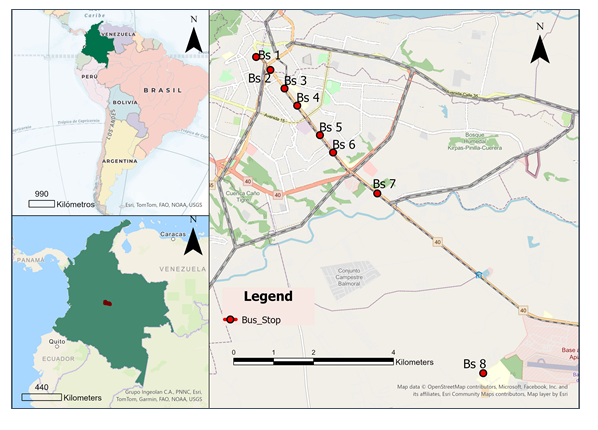
This study was conducted at bus stops along a route to a university in Villavicencio, a medium-sized city in Colombia, located in the central-eastern part of the country and with an estimated population of 538,523 people (DANE, 2020). The geographic area lies between latitudes 4° 8' 46.17" N and 73° 38' 12.22" W, and latitude 4° 4' 30.83" N and 73° 35' 7.68" W, covering a distance of 11.4 kilometers (Figure 1). This area has an average annual temperature of 27.0 °C, receives approximately 4,172.3 mm of rain per year, and is located at an altitude of 467 meters above sea level. The greatest amount of rain is concentrated between May and October, while January is the driest month (IDEAM, 2020).
Figure 1. Study area and
geographic location of the sampling.
Source: Own elaboration
During September 2024, road dust samples were collected at eight bus stops in Villavicencio. A brush and a tray were used to collect accumulated dust from areas of approximately 1 square meter at each station. Five subsamples were collected at each station along a 100-meter stretch. The sampling sites did not experience precipitation during the prior week or during the sampling period. All samples were stored in polyethylene bags, and the material was homogenized by passing it through a 2.0-mm sieve to remove larger impurities, such as organic material, stones, wires, plastic fragments, wooden chips, plant debris, bricks, and pebbles. Subsequently, all subsamples from each station were combined into a single sample. Sampling points were georeferenced using the Global Positioning System (GPS).
2.2. Chemical Analysis
A conductivity meter was used to measure the electrical conductivity (EC) of 1:5 dust/water extracts and a potentiometer to measure pH values of 1:2.5 dust/water extracts. Organic matter content (OM) (Walkley and Black, 1934). The mineralogical composition of the sample was determined by X-ray diffraction (XRD) using a diffractometer in the two-theta/theta coupled configuration with Cu Kα radiation (λ = 1.54060 Å). The analysis was performed over a 2° to 70° range, measuring the intensity of the diffraction peaks. The concentration of heavy metals (Pb, Cu, Zn, and Cd) in dust samples was determined by microwave-assisted acid digestion followed by analysis using Inductively Coupled Plasma Optical Emission Spectroscopy (ICP-OES, Perkin Elmer). A combination of strong acids was used to ensure complete dissolution of the solid matrix. Analyses were performed within a detection range of 0.002 to 200 mg kg⁻¹, depending on the metal (Pb: 0.008–50 mg kg⁻¹; Cu: 0.002–50 mg kg⁻¹; Zn: 0.01–200 mg kg⁻¹; Cd: 0.002–50 mg kg⁻¹). Quality control and reproducibility of results were ensured by performing replicate and duplicate analyses.
2.3. Pollution analysis and potential ecological risk factor
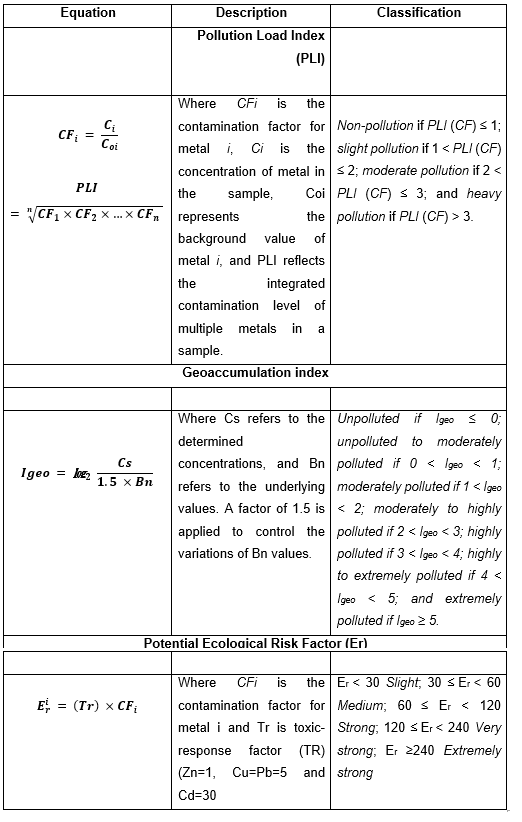
The pollution analysis was carried out using the Geoaccumulation indexes (Müller, 1982), the pollutant load index (Tomlinson et al., 1980) and the potential ecological risk factor (Håkanson 1980). The equations for the calculation are presented in Table 1.
Table 1. Pollution indices and Potential ecological risk ractor (Eᵣ)
Source: Own elaboration
2.4. Statistical Review
Descriptive statistical parameters, including mean, standard deviation (SD), coefficient of variation (CV%), along with their minimum, and maximum values were calculated. Principal Component Analysis (PCA) was also applied to analyze the road dust variables. PCA was used to reduce dimensionality and identify significant patterns and clusters among the variables, capturing the greatest variance through linear combinations. All statistical analyses were conducted using the SPSS version 25.0 program (IBM SPSS Inc., Chicago, IL, USA).
3. Results and discussion
3.1. Potentially Toxic Element Contents in road dust bus stop
Researching anthropogenic contamination by PTEs in road dust is crucial for environmental planning and monitoring in urban settings (Odediran et al., 2021; Chen et al., 2024). This study analyzed the levels of Pb, Cd, Cu, and Zn in dust samples obtained from eight sampling stations (Table 2). The results (shown in table 2) indicated PTEs levels varied between the following ranges (mg kg⁻1): Cd (1.2–0.6), Pb (44.6–15.0), Cu (115.6–17.6) and Zn (519.6–69.8) with averages of 202.3 mg kg⁻1 for Zn, 46.4 mg kg⁻1 for Cu, 27.9 mg kg⁻1 for Pb, and 0.8 mg kg⁻1 for Cd. It was found that the average levels of Pb (27.9 mg kg⁻1), Cd (0.8 mg kg⁻1), Cu (46.4 mg kg⁻1), and Zn (202.3 mg kg⁻1) were higher than the underlying levels (Pb: 11.3 mg kg⁻¹; Cd: 0.3 mg kg⁻¹; Cu: 9.9 mg kg⁻¹; Zn: 28.2 mg kg⁻¹), suggesting that human activity may have had an effect. The dust showed neutral pH (mean = 7.6), a considerable organic matter content (mean = 2.78%), and an average electrical conductivity of 0.20 dS/cm. The data showed considerable variation, with coefficients of variation of 76.0% for Zn, 86.1% for Cu, 39.4% for Pb, and 23.8% for Cd. This demonstrates that not all contaminants are distributed in the same way.
Table 2. Results and
descriptive statistics of heavy metals, organic matter, electrical
conductivity, and pH in road dust from bus stops in Villavicencio, Colombia
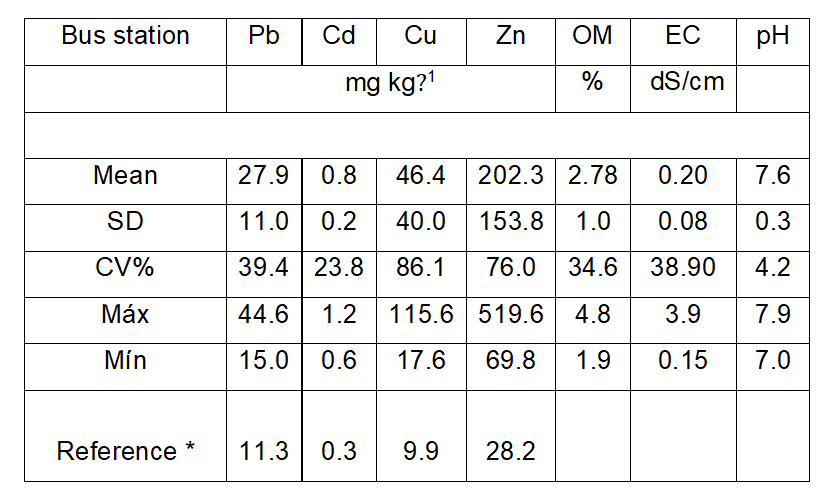
*Reference values according to Trujillo-González et al. (2022).
Source: Own elaboration
Road dust characterization and monitoring are crucial for assessing environmental quality and potential health risks, especially in urban areas. Road dust carries potentially toxic elements (PTEs) and other contaminants, which can accumulate and pose risks to both ecosystems and human health. Khan and Strand (Khan and Strand, 2018) highlight the health problems posed by road dust, stressing the need for comprehensive analyses of its composition and associated hazards. This section analyzes four essential components present in road dust and their ecological importance.
Lead (Pb)
Lead is recognized as a carcinogen derived from mining, refining, and manufacturing. However, it has had a more significant impact on the advancement of contemporary society (Ara and Usmani, 2015). The accumulation of lead in the environment is influenced mainly by vehicle emissions (Root, 2000; Milenkovic et al., 2015). Despite its restricted mobility, lead is extremely dangerous (Poggio et al., 2009). Lead concentrations in these samples ranged from 15.0 mg kg⁻¹ to 44.6 mg kg⁻¹, The Pb concentrations observed in this study are consistent with previous findings in the region. Trujillo-González et al. (2019) reported 20.7 mg kg⁻¹ of Pb in road dust along the Villavicencio highway, while Trujillo-González et al. 2025, documented 20.9 mg kg⁻¹ in Puerto López and 16.7 mg kg⁻¹ in Puerto Gaitán, two municipalities near the study area. Approximately the same amount as the global average of lead in clean soils, which was 44.0 mg kg⁻¹ (Kabata-Pendias and Pendias, 2001).
Cadmium (Cd)
Exposure to cadmium is associated with kidney disease, lung carcinoma, and osteoporosis. Industries such as paints, pigments, and electroplating use it extensively (Volensky, 1990). Cd, is highly mobile, it accumulates in the human body with prolonged exposure, resulting in chronic health problems. The levels found (0.6–1.2 mg kg⁻¹) are higher than those previously reported in the same city, where values reached 0.04 mg kg⁻¹ (Trujillo-González et al., 2019).
Copper (Cu)
Copper is used in fungicides, livestock manure, and atmospheric sedimentation due to its relatively low human toxicity (Poggio et al., 2009). Previous studies have reported an average copper concentration of 47.7 mg kg⁻¹ in road dust (Trujillo-González et al., 2019), while Cu levels in road dust from Villavicencio range between 17.6 and 115.6 mg kg⁻¹. More recent data from nearby municipalities indicate lower Cu concentrations, with 16.3 mg kg⁻¹ in Puerto López and 11.7 mg kg⁻¹ in Puerto Gaitán (Trujillo-González et al., 2025). It is also higher than the global average for pure soils, which is 20–30 mg kg⁻¹ (Alloway, 1995; Kabata-Pendias and Pendias, 2001).
Zinc (Zn)
At high concentrations, this critical mineral can exhibit neurotoxicity, which can affect cognitive function and homeostasis (Jiries, 2001). Anthropogenic sources of zinc include agrochemicals, brake pads, and abrasion from vehicles (Ward, 1990; Alengebawy et al., 2021). The Zn concentrations found in this study (42.15 to 81.30 mg kg⁻¹) concide with previous findings in the region, where Villavicencio presented an average Zn content of 118.1 mg kg⁻¹ (Trujillo-González et al., 2019). In contrast, recent studies indicate decreasing Zn levels in nearby municipalities, with 83.9 mg kg⁻¹ in Puerto López and 59.8 mg kg⁻¹ in Puerto Gaitán (Trujillo-González, 2025).
3.2. Principal Component Analysis
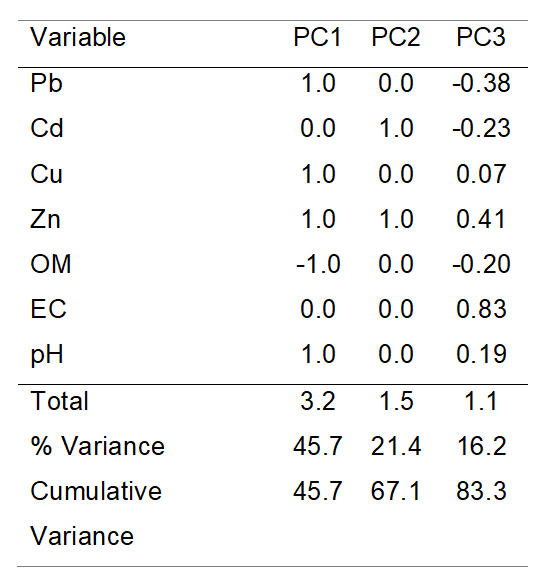
The principal component analysis (PCA) determined the main factors influencing road dust contamination in the study area (Table 3). The first principal component (PC1), which explains 45.7% of the total variability, is strongly correlated with Pb, Cu, Zn, and pH, implying that these elements are important indicators of heavy metal contamination, likely caused by vehicular traffic and urban infrastructure wear (Trujillo-González et al., 2019; Nawrot et al., 2020). In contrast, organic matter (OM) has a negative charge in this component, indicating an inverse relationship with metal accumulation. The second principal component (PC2), which accounts for 21.4% of the variance, is dominated by Cd and Zn, indicating an additional source of contamination, possibly due to tire abrasion, brake wear, and industrial waste.
Table 3. Principal component analysis (PCA) on road dust samples
Source: Own elaboration
The third principal component (PC3), which explains 16.2% of the variance, is significantly correlated with electrical conductivity (EC), suggesting that dissolved salts and soluble metals affect the chemical composition of the dust, possibly due to atmospheric deposition or leaching from urban materials (Sager, 2020). The cumulative variance of the three initial components (83.3%) indicates that these variables represent the predominant source of data variability, highlighting the collective influence of vehicular, industrial, and environmental factors on road dust contamination.
3.3. Pollution Levels and
Ecological Risk factor Assessment
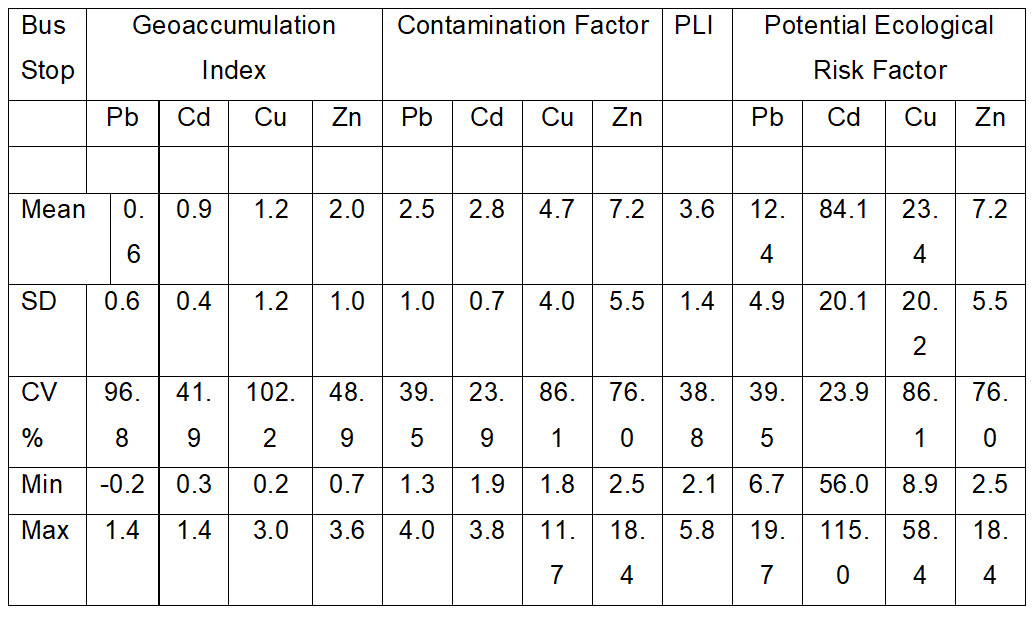
Table 4 presents the results of the indexes used to assess the environmental quality of bus stations in Villavicencio, Colombia. The use of indexes such as the Geoaccumulation Index (Igeo), the Contamination Factor (CF), the Pollution Load Index (PLI), and the Potential Ecological Risk Factor (Er) could help in assessing contamination levels concerning PTEs (Haleem et al., 2022; Nasir et al., 2023). These indicators provide a solid basis for assessing potential environmental and human health impacts, measuring contamination levels, and identifying sources (Heidari, 2021). The CF assesses contamination levels in relation to regional reference concentrations, while the Igeo assesses PTEs accumulation based on reference values. The Ecological risk (Er) assesses the ecological hazard posed by PTEs by incorporating their toxicity coefficients (Najmeddin, 2018), while the PLI offers a comprehensive assessment of contamination levels at many sampling locations (Salazar-Rojas et al., 2023).
Table 4. Contamination and ecological risk factors in road dust at bus stops.
Source: Own elaboration
The assessment of pollution and ecological risk indicators reveals a fairly wide range of pollution levels among university bus stations in Villavicencio, Colombia (a href="#f2">Figure 2). With maximum values of 3.0 for Cu (Bs 3) and 3.6 for Zn (Bs 4), the Igeo shows Cu and Zn have the highest levels of pollution. These findings imply that human activities affect the environmental quality of that area most likely through vehicle emissions, brake wear, and tire abrasion (Baensch-Baltruschat et al., 2020; Kormoker et al., 2021). Pb and Cd, on the other hand, show less accumulation. Their Igeo values fall between -0.2 and 1.4, therefore indicating either minimum to moderate pollution levels. The CF supports these findings. Copper and Zinc had maximum CF values of 11.7 (Bs 3) and 18.4 (Bs 4), thereby indicating highly contaminated areas in these locations. Although Pb and Cd show only moderate levels of contamination, their presence adds to the overall contamination burden in urban dust.
The PLI averages 3.6 ranging from 2.1 to 5.8. This indicates that many bus stops, especially at Bs 1 and Bs 4 where metal accumulation is typically higher, exhibit moderate to high levels of pollution. Cd was the main contributor at each sampling site, according to the ecological risk assessment. It had a peak value of 115 at site Bs5, which is near the very strong risk threshold, and a mean Er value of 84.1, which indicates a strong risk. This indicates the need to take extra care because cadmium is extremely toxic and persists in the environment for a long time. With mean Er values of 12.4 and 23.4, respectively, Pb and Cu were of moderate concern. However, higher levels in some hotspots, such as Bs2 for Pb and Bs3 for Cu, indicate localized emissions, most likely from fuel combustion and brake wear. Diffuse sources were identified because Zn, which had the lowest toxic response factor, showed low risk levels (average Er = 7.2) and varied considerably between areas (CV = 76%). Based on these findings, cadmium poses the greatest environmental risk in urban dust, while lead and copper should be closely monitored to reduce the likelihood of further problems.
3.4. Mineralogical composition of Road Dust
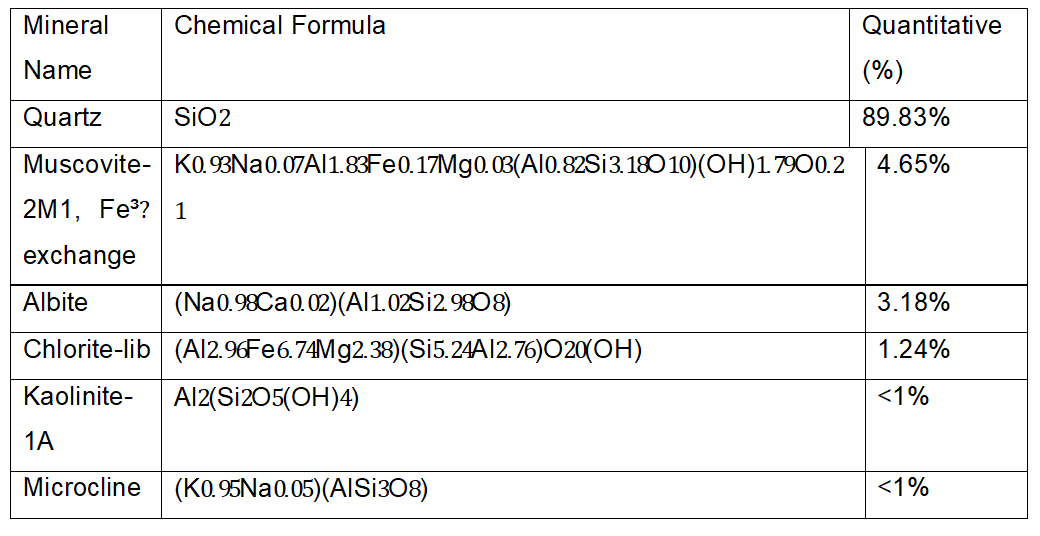
The mineralogical composition of road dust is a heterogeneous amalgamation of natural and artificial elements, with variations influenced by geographical location and adjacent activities. The mineralogical analysis, performed using X-ray diffraction (Table 5, Figure 3 and 4), indicated that quartz (SiO₂) was the main mineral, representing approximately 90% of the total composition. Other minerals were contained in smaller amounts including muscovite (4.65%) [(K₀.₉₃Na₀.₀₇Al₁.₈₃Fe₀.₁₇Mg₀.₀₃(Al₀.₈₂Si₃.₁₈)]), albite (3.18%) [(Na₀.₉₈Ca₀.₀₂)(Al₁.₀₂Si₂.₉₈O₈)]), and chlorite (1.24%) [((Al₂.₉₆Fe₆.₇₄Mg₂.₃₈)(Si₅.₂₄Al₂.₇₆) In addition, traces of kaolinite [(Al₂(Si₂O₅(OH)₄)] and microcline [(K₀.₉₅Na₀.₀₅)(AlSi₃O₈)] were identified.
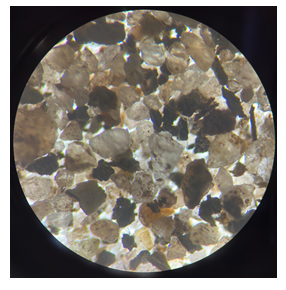
Figure 2. Observation of road dust samples at 2X magnification using a stereoscopic microscope (SteREO Discovery.V8, ZEISS; Carl Zeiss Canada).
Source: Own elaboration
These results support previous work by Candeias et al. (Candeias et al., 2020), who also found that quartz was the main mineral, especially in the coarse fraction. Other minerals found were muscovite [(KAl₃Si₀O₁₀(OH)₂)], albite [(NaAlSi₀O₈)], kaolinite [(Al₂Si₂O₅(OH)₄)], microcline [(KAlSi₀O₈)], Fe-enstatite [(Fe,Mg)₂Si₂O₆], and graphite [(C)]. As noted by Gunawardana et al. (Gunawardana et al., 2012) the minerals found probably come from weathered rock and clay fractions with low detection thresholds, as well as from artificial sources.
Table 5. Mineralogical analysis obtained from x-ray diffraction of a composite sample of road dust taken from eight bus stop subsamples
Source: Own elaboration
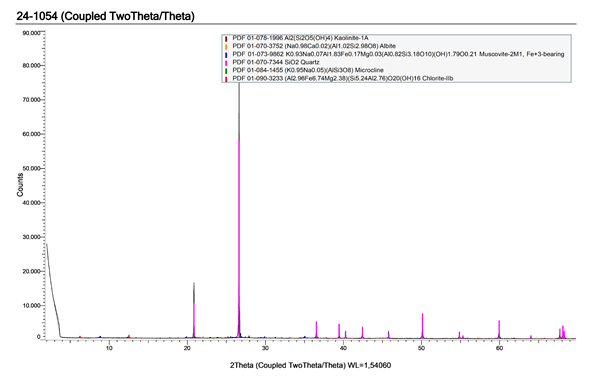
Figure 4. X-ray diffractogram of a composite sample of road dust taken from eight bus stop subsamples
Source: Own elaboration
The mineralogical analysis of road dust is essential to determine its origin, whether natural (rock weathering, soil resuspension) or anthropogenic (vehicle emissions, industrial operations) (Navarro-Ciurana et al., 2023). According to the data, the components of road dust are modified by both natural processes, such as rock weathering, and human activities, such as infrastructure construction and car emissions. The prevalence of quartz is consistent with prior research on urban dust, indicating its role as a conduit for heavy metals. Understanding the mineral composition of dust is crucial for assessing air quality as certain minerals can contain hazardous compounds or cause respiratory problems. This information also helps to identify contamination sources, facilitates environmental monitoring, and guides urban planning policies aimed at reducing health risks and environmental damage.
Conclusions
This research provides a comprehensive assessment of PTEs contamination in road dust at the university bus stop in Villavicencio, Colombia. The amounts of Pb (15.0–44.6 mg kg⁻¹`), Cd (0.6–1.2 mg kg⁻¹), Cu (17.6–115.6 mg kg⁻¹), and Zn (69.8–519.6 mg kg⁻¹) are much higher than what other studies have found in the area and what are the background levels. These high levels underscore the impact of human activities, especially vehicular emissions, brake degradation, and tire erosion. Igeo classifies the amount of Cu and Zn contamination as moderate to high. Maximum values of 3.0 Cu at Bs 3 and 3.6 Zn at Bs 4 indicate that these areas have significant contamination. The CF corroborates these results, indicating maximum values of 11.7 for Cu (Bs 3) and 18.4 for Zn (Bs 4). The PLI varies from 2.1 to 5.8, with a mean of 3.6, indicating widespread contamination. The most hazardous element is Cd, which has the highest Er value of Bs 5 (115.0). Therefore, it is considered a very heavy contaminant.
In addition to metal contamination, a study of the minerals present in road dust shows that quartz (SiO₂) is the predominant mineral, representing approximately 90% of the total. Other minerals found are muscovite (4.65%), albite (3.18%), chlorite (1.24%), and small amounts of kaolinite and microcline. From a public health perspective, these results highlight the importance of systematic monitoring programs and targeted mitigation strategies to reduce human exposure to hazardous metals in cities. Authorities should implement more stringent pollution control measures, including improved road dust management and stricter emission limits, particularly in high-traffic areas such as bus stops. Further research is needed on the bioavailability of these elements, their interaction with mineral phases, and their long-term impact on health and the environment.
Acknowledgments
The authors gratefully acknowledge the support provided by Universidad de los Llanos and the Instituto de Ciencias Ambientales de la Orinoquía Colombiana (ICAOC) for facilitating the development of this research.
Conflict of interest: The authors declare none.
References
Abu Khatita AM. (2023). Risk assessment of potentially toxic elements in street dust from Mahd Ad Dhahab gold mine, Saudi Arabia. Journal of Taibah University for Science, 18(1). https://doi.org/10.1080/16583655.2023.2281067
Adachi K, Tainosho Y. (2005). Single particle characterization of size-fractionated road sediments. Applied Geochemistry, 20(5), 849-859. https://doi.org/10.1016/j.apgeochem.2005.01.005
Adimalla N, Qian H, Nandan MJ, Hursthouse AS. (2020). Potentially toxic elements (PTEs) pollution in surface soils in a typical urban region of south India: An application of health risk assessment and distribution pattern. Ecotoxicology and Environmental Safety, 203, 111055. http://dx.doi.org/10.1016/j.ecoenv.2020.111055
Alengebawy A, Abdelkhalek ST, Qureshi SR, Wang MQ. (2021). Heavy metals and pesticides toxicity in agricultural soil and plants: Ecological risks and human health implications. Toxics, 9(3), 42. http://dx.doi.org/10.3390/toxics9030042
Alloway BJ. (1995). Heavy metals in soils. Blackie Academic and Professional. An Imprint of Chapman & Hall. Glasgow. https://doi.org/10.1007/978-94-011-1344-1
Amato F, Pandolfi M, Viana M, Querol X, Alastuey A, Moreno T. (2009). Spatial and chemical patterns of PM10 in road dust deposited in urban environment. Atmospheric Environment, 43(9), 1650-1659. https://doi.org/10.1016/j.atmosenv.2008.12.009
Ara, A., & Usmani, J. A. (2015). Lead toxicity: a review. Interdisciplinary toxicology, 8(2), 55. https://doi.org/10.1515/intox-2015-0009
Baensch-Baltruschat B, Kocher B, Stock F, Reifferscheid G. (2020). Tyre and road wear particles (TRWP)-A review of generation, properties, emissions, human health risk, ecotoxicity, and fate in the environment. Science of the total Environment, 733, 137823. https://doi.org/10.1016/j.scitotenv.2020.137823
Candeias C, Vicente E, Tomé M, Rocha F, Ávila P, Célia A. (2020). Geochemical, mineralogical and morphological characterisation of road dust and associated health risks. International journal of environmental research and public health, 17(5), 1563. doi: 10.3390/ijerph17051563. https://doi.org/10.3390/ijerph17051563
Chen L, Fang L, Yang X, Luo X, Qiu T, Zeng Y, Rinklebe J. (2024). Sources and human health risks associated with potentially toxic elements (PTEs) in urban dust: A global perspective. Environment International, 187, 108708. https://doi.org/10.1016/j.envint.2024.108708
Cheng H, Shen R, Chen Y, Wan Q, Shi T, Wang J, Li X. (2019). Estimating heavy metal concentrations in suburban soils with reflectance spectroscopy. Geoderma, 336, 59-67. https://doi.org/10.1016/j.geoderma.2018.08.010
DANE. Obtenido de Estimación de población 1985–2005 y proyecciones de población 2005–2020 total municipal por área. Available online: https://www.dane.gov.co/files/investigaciones/poblacion/proyepobla06_20/Municipal_area_1985-2020.xls(accessed on 15 May 2025).
Duzgoren-Aydin NS, Wong C, Aydin A, Song Z, You M, Li XD. (2006). Heavy metal contamination and distribution in the urban environment of Guangzhou, SE China. Environmental geochemistry and health, 28, 375-391. https://doi.org/10.1007/s10653-005-9036-7
Faiz Y, Tufail M, Javed MT, Chaudhry MM. (2009). Road dust pollution of Cd, Cu, Ni, Pb and Zn along islamabad expressway, Pakistan. Microchemical Journal, 92(2), 186-192. https://doi.org/10.1016/j.microc.2009.03.009
Feng W, Guo Z, Peng C, Xiao X, Shi L, Zeng P, Xue Q. (2019). Atmospheric bulk deposition of heavy metal (loid) s in central south China: Fluxes, influencing factors and implication for paddy soils. Journal of Hazardous Materials, 371, 634-642. https://doi.org/10.1016/j.jhazmat.2019.02.090
Gunawardana C, Goonetilleke A, Egodawatta P, Dawes L, Kokot S. (2012). Source characterisation of road dust based on chemical and mineralogical composition. Chemosphere, 87(2), 163-170. https://doi.org/10.1016/j.chemosphere.2011.12.012
Håkanson L. (1980). An ecological risk index for aquatic pollution control: A sedimentological approach. Water Research, 14(8), 975-1001. https://doi.org/10.1016/0043-1354(80)90143-8
Haleem A, Amin S, Mahdi R. (2022). Assessment of health risk and geo-accumulation of toxic heavy metals in side-road dust from urban areas of Baghdad city. Public Health Toxicology, 2(3), 1-10. https://doi.org/10.18332/pht/153466
Heidari M, Darijani T, Alipour V. (2021). Heavy metal pollution of road dust in a city and its highly polluted suburb; quantitative source apportionment and source-specific ecological and health risk assessment. Chemosphere, 273, 129656. https://doi.org/10.1016/j.chemosphere.2021.129656
IDEAM. Promedio climatológico 1981–2010. Inst. Hidro., Meteorol. y Estudios Ambien. 2020. Available online: https://cgsm.cemarin.org/tipodoc/informe/ideam-2020-promedio-climatologico-1981-2010-inst-hidro-meteorol-y-estudios-ambien/ (ac-cessed on 15 May 2025).
Jeong H, Ra K. (2022). Pollution and Health Risk Assessments of Potentially Toxic Elements in the Fine-Grained Particles (10−63 µm and <10 µm) in Road Dust from Apia City, Samoa. Toxics, 10(11):683. https://doi.org/10.3390/toxics10110683.
Jiries AG, Hussein HH, Halaseh Z. (2001). The quality of water and sediments of street runoff in Amman, Jordan. Hydrological processes, 15(5), 815-824. https://doi.org/10.1002/hyp.186
Kabata-Pendias A, Pendias H. (2001). Trace elements in soils and plants CRC Press Inc. Boca Raton, FL, USA.
Khan RK, Strand MA. (2018). Road dust and its effect on human health: a literature review. Epidemiology and health, 40, e2018013. https://doi.org/10.4178/epih.e2018013
Kormoker T, Kabir MH, Khan R, Islam MS, Shammi RS, Al MA, Idris AM. (2021). Road dust–driven elemental distribution in megacity Dhaka, Bangladesh: Environmental, ecological, and human health risks assessment. Environmental Science and Pollution Research, 1-22. https://doi.org/10.1007/s11356-021-14581-3
Li C, Li F, Wu Z, Cheng J. (2017). Exploring spatially varying and scale-dependent relationships between soil contamination and landscape patterns using geographically weighted regression. Applied Geography, 82: 101-114. https://doi.org/10.1016/j.apgeog.2017.03.007
Li C, Sun G, Wu Z, Zhong H, Wang R, Liu X, Guo Z, Cheng J. (2019). Soil physiochemical properties and landscape patterns control trace metal contamination at the urban-rural interface in southern China. Environmental Pollution, 250, 537–545. https://doi.org/10.1016/j.envpol.2019.04.065
Meza-Figueroa D, De la O-Villanueva M, De la Parra ML. (2007). Heavy metal distribution in dust from elementary schools in Hermosillo, Sonora, México. Atmospheric Environment, 41(2), 276-288. https://doi.org/10.1016/j.atmosenv.2006.08.034
Milenkovic B, Stajic JM, Gulan LJ, Zeremski T, Nikezic D. (2015). Radioactivity levels and heavy metals in the urban soil of Central Serbia. Environmental Science and Pollution Research, 22, 16732-16741. https://doi.org/10.1007/s11356-015-4869-9
Müller G. (1989). Index of geoaccumulation in sediments of the Rhine River. GeoJournal, 2, 108–118
Najmeddin A, Keshavarzi B, Moore F, Lahijanzadeh A. (2018). Source apportionment and health risk assessment of potentially toxic elements in road dust from urban industrial areas of Ahvaz megacity, Iran. Environmental geochemistry and health, 40, 1187-1208 https://doi.org/10.1007/s10653-017-0035-2
Nasir MJ, Wahab A, Ayaz T, Khan S, Khan AZ, Lei M. (2023). Assessment of heavy metal pollution using contamination factor, pollution load index, and geoaccumulation index in Kalpani River sediments, Pakistan. Arabian Journal of Geosciences, 16(2), 143. https://doi.org/10.1007/s12517-023-11231-5
Navarro-Ciurana D, Corbella M, Farré-de-Pablo J, Corral I, Buixadera E, Morera-Valverde R, Proenza JA. (2023). Rare Earth Elements’ particles in road dust: A mineralogical perspective for source identification. Atmospheric Environment, 309, 119927. https://doi.org/10.1016/j.atmosenv.2023.119927
Nawrot N, Wojciechowska E, Rezania S, Walkusz-Miotk J, Pazdro K. (2020). The effects of urban vehicle traffic on heavy metal contamination in road sweeping waste and bottom sediments of retention tanks. Science of the Total Environment, 749, 141511. https://doi.org/10.1016/j.scitotenv.2020.141511
Nezat CA, Hatch SA, Uecker T. (2017). Heavy metal content in urban residential and park soils: A case study in Spokane, Washington, USA. Applied Geochemistry, 78, 186-193. https://doi.org/10.1016/j.apgeochem.2016.12.018
Odediran ET, Adeniran JA, Yusuf RO, Abdulraheem KA, Adesina OA, Sonibare JA, Du M. (2021). Contamination levels, health risks and source apportionment of potentially toxic elements in road dusts of a densely populated African City. Environmental Nanotechnology, Monitoring & Management, 15, 100445. https://doi.org/10.1016/j.enmm.2021.100445
Ordonez A, Loredo J, De Miguel E, Charlesworth S. (2003). Distribution of heavy metals in the street dusts and soils of an industrial city in Northern Spain. Archives of Environmental Contamination and Toxicology, 44, 0160-0170. https://doi.org/10.1007/s00244-002-2005-6
Pecina V, Brtnický M, Baltazár T, Juřička D, Kynický J, Galiová MV. (2021). Human health and ecological risk assessment of trace elements in urban soils of 101 cities in China: A meta-analysis. Chemosphere, 267, 129215.
Poggio L, Vrščaj B, Schulin R, Hepperle E, Marsan FA. (2009). Metals pollution and human bioaccessibility of topsoils in Grugliasco (Italy). Environmental Pollution, 157(2), 680-689. https://doi.org/10.1016/j.envpol.2008.08.009
Root RA. (2000). Lead loading of urban streets by motor vehicle wheel weights. Environmental health perspectives, 108(10), 937-940. https://doi.org/10.2307/3435051
Sager M. (2020). Urban soils and road dust—civilization effects and metal pollution—a review. Environments, 7(11), 98. https://doi.org/10.3390/environments7110098
Salazar-Rojas T, Cejudo-Ruiz FR, Gutiérrez-Soto MV, Calvo-Brenes G. (2023). Assessing heavy metal pollution load index (PLI) in biomonitors and road dust from vehicular emission by magnetic properties modeling. Environmental Science and Pollution Research, 30(39), 91248-91261. https://doi.org/10.1007/s11356-023-28758-5
Tomlinson DL, Wilson JG, Harris CR, Jeffrey DW. (1980). Problems in the assessment of heavy-metal levels in estuaries and the formation of a pollution index. Helgoländer meeresuntersuchungen, 33, 566-575. https://doi.org/10.1007/bf02414780
Trujillo-González JM, Sastre-Piñeros U, Morales-Espitia FJ. (2025). Análisis comparativo de metales pesados en el polvo vial de dos municipios del meta, Colombia. Revista de Investigación Agraria y Ambiental, 16(1), 339-356. https://doi.org/10.22490/21456453.8243
Trujillo-González JM, Torres-Mora MA, Jiménez-Ballesta R, Zhang J. (2019). Land-use-dependent spatial variation and exposure risk of heavy metals in road-deposited sediment in Villavicencio, Colombia. Environmental geochemistry and health, 41, 667-679. https://doi.org/10.1007/s10653-018-0160-6
Trujillo-González JM, Torres-Mora MA, Serrano-Gomez M, Castillo-MonroyEF, Ballesta RJ. (2022). Baseline values and environmental assessment for metal (loid) s in soils under a tropical rainy climate in a Colombian region. Environmental Monitoring and Assessment, 194(7), 494. https://doi.org/10.1007/s10661-022-10036-5
Volensky B. (1990) Removal and recovery of heavy metals by biosorption. Biosorption of heavy metals. Boston: CEC Press. https://doi.org/10.1007/s10661-022-10036-5
Walkley A, Black IA. (1934). An examination of the Degtjareff method for determining soil organic matter, and a proposed modification of the chromic acid titration method. Soil Science, 37(1),29–38. https://doi.org/10.1097/00010694-193401000-00003
Ward NI. (1990). Multielement contamination of British motorway environments. Science of the Total Environment, 93, 393-401. https://doi.org/10.1016/0048-9697(90)90130-M
Yang Z, Li X, Wang Y, Chang J, Liu X. (2021). Trace element contamination in urban topsoil in China during 2000–2009 and 2010–2019: pollution assessment and spatiotemporal analysis. Science of the Total Environment, 758, 143647. https://doi.org/10.1016/j.scitotenv.2020.143647
Zhou XY, Wang XR. (2019). Impact of industrial activities on heavy metal contamination in soils in three major urban agglomerations of China. Journal of Cleaner Production, 230, 1-10. https://doi.org/10.1016/j.jclepro.2019.05.098
Zupančič N. (2017). Influence of climate factors on soil heavy metal content in Slovenia. Journal of Soils and Sediments, 17, 1073-1083. https://doi.org/10.1007/s11368-016-1614-z
1 Estudiante de ingeniería Ambiental. Universidad de los Llanos. Villavicencio, Colombia. sebastian.ocano@unillanos.edu.co. https://orcid.org/0009-0009-9665-7966
2 Estudiante de ingeniería Ambiental. Universidad de los Llanos. Villavicencio, Colombia. uwerney.sastre@unillanos.edu.co. https://orcid.org/0009-0006-2288-7070
3 PhD en Tecnologías Energéticas y Ambientales para el Desarrollo, Universidad de los Llanos, Facultad de Ciencias Básicas e Ingeniería. Instituto de Ciencias Ambientales de la Orinoquia Colombiana. Grupo de Investigación en Gestión Ambiental Sostenible. Villavicencio, Colombia marcotorres@unillanos.edu.co. https://orcid.org/0000-0002-3824-5412
4 PhD.en Química Agrícola, Universidad de los Llanos, Facultad de Ciencias Básicas e Ingeniería. Instituto de Ciencias Ambientales de la Orinoquia Colombiana. Grupo de Investigación en Gestión Ambiental Sostenible. Villavicencio, Colombia. jtrujillo@unillanos.edu.co. ORCID: https://orcid.org/0000-0001-9612-4080
5 PhD, , Autonomous University of Madrid, Spain, correo electrónico: profe.raimundojimenez@gmail.com. ORCID: https://orcid.org/0000-0002-4048-0892
To cite this article: Ocaño-Hernández, S., Sastre-Piñeros, U., Torres-Mora, M. A., Trujillo-González, J. M., & Jiménez Ballesta, R.(2026). Environmental Assessment of Road Dust at Bus Stops in Villavicencio, Colombia. Revista Luna Azul, (62), 189-207. DOI: https://doi.org/10.17151/luaz.2026.62.11
This
work is licensed under a Creative Commons
Attribution CC BY License.

Código
QR del artículo