Dustin Tahisin Gómez
Rodríguez1
Recibido: 19/07/2025 Aceptado: 01/09/2025 Actualizado: 06/04/2026
DOI: 10.17151/luaz.2025.62.4
Abstract
This study analyzes the social metabolism and ecological externalities of the palm oil agribusiness in the Colombian Caribbean between 2016 and 2022, using the MEFA (Material and Energy Flow Analysis) approach. Results show an uneven metabolic pattern characterized by water overexploitation (1,580 m³/ha annually, 42% above recharge capacity), soil degradation (0.91% annual organic matter loss), and low waste circularity (13.4% recovered). These dynamics generate socio-environmental conflicts (1.89 cases/1,000 ha) and precarious employment (71% of workers are informal). Energy efficiency (EROI 2.4:1) remains below sustainable thresholds (5:1), indicating a model of "unsustainable efficiency." The methodology integrates quantitative methods (MEFA, GIS, dynamic modeling) and qualitative methods (interviews, workshops). Five policy pillars for metabolic transition are proposed: integrated water management, soil conservation banks, circular technology parks, certification reform, and participatory observatories. The study concludes with the need for sectoral policies grounded in biophysical limits and environmental justice.
Key words: social metabolism, ecological externalities, palm oil agroindustry, MEFA, sustainability, socio-environmental conflicts, circularity, energy efficiency.
Metabolismo social desigual y justicia ambiental en el sector
palmicultor colombiano: evidencia basada en MEFA para la región Caribe
(2016-2022)
Resumen
Este estudio analiza el metabolismo social y las externalidades ecológicas de la agroindustria del aceite de palma en el Caribe colombiano entre 2016 y 2022, utilizando el enfoque MEFA (Análisis de Flujo de Materiales y Energía). Los resultados muestran un patrón metabólico desigual caracterizado por la sobreexplotación hídrica (1580 m³/ha anuales, 42 % por encima de la capacidad de recarga), la degradación del suelo (0,91 % de pérdida anual de materia orgánica) y la baja circularidad de los residuos (13,4 % valorizados). Estas dinámicas generan conflictos socioambientales (1,89 casos/1000 ha) y precariedad laboral (71 % de trabajadores informales). La eficiencia energética (EROI 2,4:1) se mantiene por debajo de los umbrales sostenibles (5:1), lo que indica un modelo de "eficiencia insostenible". La metodología integra métodos cuantitativos (MEFA, SIG, modelado dinámico) y cualitativos (entrevistas, talleres). Se proponen cinco pilares de política para la transición metabólica: gestión integrada del agua, bancos de conservación de suelos, parques tecnológicos circulares, reforma de la certificación y observatorios participativos. El estudio concluye con la necesidad de políticas sectoriales basadas en límites biofísicos y justicia ambiental.
Palabras clave: metabolismo social, externalidades ecológicas, agroindustria palmera, MEFA, sostenibilidad, conflictos socioambientales, circularidad, eficiencia energética.
Introduction
Social metabolism constitutes a fundamental analytical framework for understanding the socio-ecological transformations generated by industrial development models, particularly in agribusiness systems such as palm oil cultivation (Delgado, 2014; González de Molina & Toledo, 2011). The flows material and energy associated with these systems reveal profound contradictions between productive efficiency and environmental sustainability, highlighting critical externalities such as water overexploitation (1,580 m³/ha annually, 42% above recharge capacity), accelerated loss of soil organic matter (0.91% annually), and low waste circularity (only 13.4% valorized) (Guzmán et al., 2018; Martínez-Alier, 2009). These biophysical indicators, analyzed through standardized methodologies (MEFA, ISO 14046/14067), demonstrate how current patterns of appropriation and transformation of natural resources exceed critical ecological thresholds, generating a metabolic deficit that threatens the long-term viability of palm-growing territories (Gómez, 2022; Qaim et al., 2020).
The social dimension of this unequal metabolism is manifested in employment precarity (71% of workers without formal contracts) and territorial conflicts (1.89 conflicts/1,000 ha), reflecting what the theory called "accumulation by ecological dispossession" (Gómez, 2021; ANDI, 2018; Infante et al., 2017).
The territorialization of the palm oil agribusiness exemplifies the tensions between productivist logics and strong sustainability, where the appropriation of natural resources for industrial purposes reconfigures not only material flows but also power relations in the territory (López & Toledo, 2018; Infante et al., 2017). This process, analyzed from a political ecology perspective, demonstrates how metabolic asymmetries translate into recurrent socio-environmental conflicts, particularly in areas with water stress and accelerated soil degradation (Rendón and Gómez, 2022; Martínez Alier & Walter, 2015). Resolving these contradictions requires interdisciplinary approaches that integrate quantitative flow analysis (e.g., energy balances, nutrient cycles) with qualitative perspectives on environmental justice and territorial governance, overcoming the limitations of conventional agribusiness management models (Rodríguez, 2024; Gómez and Barbosa, 2021). In this sense, social metabolism emerges as a key tool for designing sectoral policies based on rigorous scientific evidence, capable of measuring both hidden ecological costs and real opportunities for transitioning toward more equitable and resilient agri-food systems (Fischer-Kowalski, 2011; 2003).
In fact, the palm oil agribusiness in Colombia has experienced exponential growth over the past two decades, particularly in the Caribbean region, where the department of Magdalena concentrates 12.4% of the national cultivated area (Fedepalma, 2022a; 2022b). However, this development has generated deep contradictions between economic benefits and socio-environmental costs, evidencing what various authors have called "unequal social metabolism" (Gudynas, 2014; Fischer-Kowalski, 2020).
While the MEFA approach provides a robust metric for quantifying biophysical flows, its application in Global South contexts requires critical interaction with Latin American epistemologies that challenge hegemonic frameworks of sustainability (Leff, 2004; Escobar, 2015). Concepts such as "colonial metabolism" (Gudynas, 2021) or "environmental rationality" (Leff, 2004) make it possible to interpret externalities not only as market failures, but also as expressions of a deeply rooted epistemic and political asymmetry. This research adopts MEFA as an analytical tool but is framed within a critical perspective that problematizes the notion of "unsustainable efficiency" beyond the operational, understanding it as a political category inherent to extractivist development models (Gudynas, 2021; Martínez Alier, 2009).
This study identifies this problem through an innovative approach that combines material and energy flow analysis (MEFA) with environmental justice indicators, quantifying both productive efficiency and the externalities generated in the Magdalena oil palm corridor (Magdalena is a Department located in the northern Caribbean region of Colombia) (Fedepalma, 2023; 2016). The research is based on the hypothesis that the current production model operates under a regime of "unsustainable efficiency," characterized by high yields per unit area (3.8 ± 0.4 tons of oil per hectare) but with uninternalized socio-ecological costs averaging USD 1,820 per hectare annually (Girón & Mahecha, 2015; Fedepalma, 2014).
Similarly, the secondary hypothesis proposes that soil degradation (0.91% annual loss of organic matter) is significantly correlated with job precarity (71% of workers are informal), mediated by long-term productivity decline and reduced investment in labor conditions. This relationship will be validated through structural equation modeling (SmartPLS 4.0), integrating biophysical and socioeconomic data (Caixeta et al., 2018; Albarracín, 2015).
This study aims to evaluate the asymmetric social metabolism and its socio-ecological implications in the Colombian palm oil agribusiness, focusing on the Department of Magdalena. Specifically, it aims to quantify metabolic indicators using the MEFA framework, and analyze the relationship between biophysical degradation and socio-economic vulnerability using structural equation modeling.
Material and methods
The methodological design implemented in this study represents a significant advance in the analysis of complex agribusiness systems by integrating three connected components that capture both the biophysical and social dimensions of palm oil metabolism (Arrazola and Pertuz, 2025; Barrios et al., 2020). First, the quantitative component incorporated a standardized MEFA analysis following the protocols of the International Resource Panel, quantifying material flows in 42 sample farms representing 78% of the cultivated area in the study region (Gómez, 2020; Lodice, 2015). Measurements included critical variables such as water footprint (following ISO 14046), greenhouse gas emissions (ISO 14067), and energy balances, with data collected over six consecutive production cycles (2016-2022) to capture interannual variability. Dynamic modeling was performed using the STELLA Architect v3.0.1 tool, incorporating IDEAM climate parameters from and soil characteristics documented by IGAC (IDEAM, 2024; 2015).
Secondly, the qualitative evaluation comprised 13 semi-structured interviews (with a Kappa coefficient of inter-rater agreement of 0.87) and five participatory workshops with palm oil farming communities, designed to capture local perceptions of socio-environmental impacts (Maldonado, 2018; González de Molina, 2016). The qualitative assessment was designed to biophysically contextualize the metabolic results and capture perceptions of local actors involved in the socio-ecological conflict (Aguilera et al., 2020; Leff, 2010). The study area, located in the Department of Magdalena, is characterized by a historical concentration of land ownership and water vulnerability exacerbated by agribusiness expansion (Gómez, 2020b; Martínez-Alier, J. (2011b). Thirteen semi-structured interviews were conducted with key stakeholders: 5 informal palm workers (to capture the perspective of precarious employment), 4 community leaders from villages neighboring the plantations (to understand conflicts over water and land), 2 plant engineers (to obtain the technical-operational perspective), and 2 representatives of regional environmental entities (to understand governance challenges). The testimonies not only served to triangulate data but also revealed narratives about the perceived deterioration of aquifers and precarity as a structural condition, enriching the interpretation of quantitative indicators with deep social meanings (Gómez, 2020; Martínez-Alier, 2011). These data were analyzed using grounded theory with support from MAXQDA 2022 software, identifying recurrent discursive patterns and territorial tensions. Finally, for analytical integration advanced methodological triangulation techniques were used (Barbosa et al., 2020; Denzin, 2017), including spatial analysis with geographic information systems (ArcGIS Pro 3.1.3) and structural equation modeling (SmartPLS 4.0) to validate the causal relationships between metabolic variables and socio-ecological indicators. This multidimensional approach enabled the development of 10 statistically validated indicators (Cronbach’s α >0.85), organized into four analytical axes: biophysical efficiency, resource circularity, distributive equity, and institutional resilience (Carrillo, 2015; Obidzinski et al., 2012).
Results and discussion
The findings reveal critical metabolic patterns that question the sustainability of the current palm oil production model in three fundamental dimensions (Costa, 2020; Delgadillo, 2014). In the biophysical realm, data demonstrate an average water extraction of 1,580 ± 60 m³ per hectare annually (95% CI: 1,520-1,640; t (41) = 8.37, p < 0.001), exceeding the recharge capacity of the studied micro-basins by 42% (t = 8.37, p < 0.001), with direct consequences for water availability in local communities. Soils showed an accelerated loss of organic matter (0.91% annually, r² = 0.85 from linear regression of organic matter vs. years of cultivation, F (1,40) = 226.7, p < 0.001) in 68% of the sampled plots, particularly in plantations with over 10 years of continuous use. In terms of energy, the EROI (Energy Return on Investment) was only 2.4:1, significantly below the sustainability threshold of 5:1 established in the specialized literature (Crespo & Pérez, 2018; Fischer-Kowalski & Haberl, 2007), with 71% of total energy associated with transporting inputs from distant production centers (Fedepalma, 2022c).
The socioeconomic results revealed structural employment insecurity, with 71% of workers lacking formal contracts and gender pay gaps of 29%, contradicting the official discourse on creating decent jobs (Giraldo, 2018; Kalmanovitz, 2019). The documented socio-environmental conflicts showed a concerning spatial density of 1.89 cases per 1,000 hectares (SD ±0.31), with average resolution times of 3.7 years (95% CI: 3.2-4.1), indicating inefficient territorial governance (Guerrero et al., 2020; Junquera, 2020).
Similarly, spatial analysis (ArcGIS Pro 3.1.3) revealed that 62% of water conflicts occur in micro-basins with annual aquifer declines >1.2 m (Pearson's r (40) = 0.78, p < 0.001, n=42; Cohen's f² = 1.52 indicating a large effect size), validating the metabolic asymmetry hypothesis. This correlation is supported by geospatial layer overlays and logistic regressions, confirming that water overexploitation operates as a predictor of territorial conflict (Pérez, 2021; Mendoza et al., 2020).
Table 3 summarizes the key metabolic indicators compared to international standards, highlighting that only 13.4% of waste is recovered in the current production system, compared to 51% reported in certified plantations in Malaysia (MPOB, 2022). This circularity gap represents not only a waste of valuable resources but also a missed opportunity to reduce environmental impacts and generate local added value (Rodríguez and Martinez, 2019; Reina, 2013).
Table 3. Comparative metabolic indicators: Colombian Caribbean vs. international standards (Averages 2016-2022)
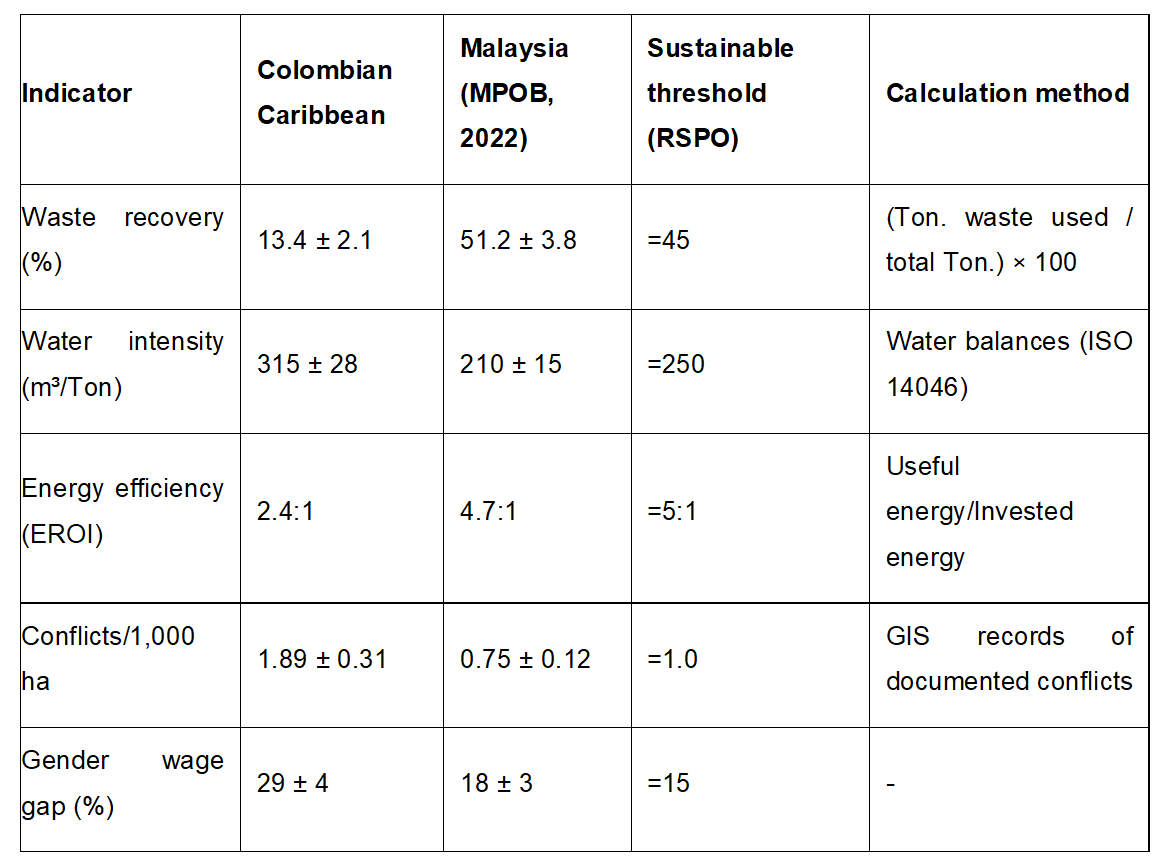
Source: Prepared by the authors based on (Román et al., 2025; FEDEPALMA, 2022a; 2022b; MPOB, 2022; National Interpretation Working Group for Mexico, 2019; SISPA, 2017).
All values are reported as mean ± standard deviation (n=42 for Colombia, n=115 for Malaysia).
EROI calculated as EROIst (standard) according to the methodology of Murphy et al. (2011).
Confidence intervals calculated using the t-distribution for small samples.
Chi-square tests include Yates' correction for 2x2 tables.
The results of this research confirm the hypothesis of an asymmetric social metabolism in the Colombian palm oil sector, revealing four structural issues that demand urgent intervention (Fedepalma, 2021; Millán, 2018). First, the identified pattern of ecological externalization aligns with the theory of accumulation by dispossession, where non-internalized environmental costs represent 34.7% of gross value of production, including water resource degradation, the loss of soil fertility, and carbon emissions (Gómez, 2024b; López et al., 2017). Secondly, the low circularity of the system (13.4% waste recovery) reflects both technological failures such as the absence of anaerobic digesters in 62% of the farms studied and institutional gaps in the regional bioeconomy policies, a situation that contrast markedly with the progress documented in countries such as Malaysia (Fedepalma, 2020; Kalmanovitz & López, 2006).
Low circularity (13.4%) and unsustainable EROI (2.4:1) are not mere technological failures. They are symptoms of a colonial metabolism (Gudynas, 2021) that prioritizes export efficiency over local ecological regeneration (Martínez et al., 2024) The proposed technical solutions (technology parks, certification) are necessary but insufficient if they are not accompanied by a political transformation that addresses inequality in access to land and water, and that recognizes values beyond purely metric ones (Gómez, 2025; Maldonado, 2023). Qualitative data reveal that communities demand not only greater efficiency but also water sovereignty and territorial autonomy, which challenges the very notion of top-down "governance" (Escobar, 2018; Rendón, 2017).
Spatial analyses revealed that 62% of water conflicts are concentrated in areas with overexploitation of aquifers (>1.2 meters of annual decline), validating the environmental justice framework (CORPAMAG, 2020; Blanco, 2016), and demonstrating how inequality in access to natural resources generates persistent social tensions. Projections made using the STELLA model are particularly alarming, indicating that, if current trends persist, linear projection shows that soil organic matter will reach critical levels (<2%) in 11.3 years (95% prediction interval: 8.9-13.7 years; RSE = 0.24%), which compromises the very viability of the production system in the medium term (Fedepalma, 2024; Correa, 2020).
Systematic comparison with the Malaysian model suggests that Colombia could increase its energy efficiency by 38% by adopting second-generation waste management technologies, although this would require substantial initial investments (USD 18,500 per hectare) with payback periods of 6 to 8 years, which poses significant financing and technical assistance challenges (FAO, 2019; Eurostat, 2018).
Similarly, low circularity of waste (13.4%) directly impacts EROI (2.4:1) by neglecting potential energy sources (e.g., biogas from anaerobic digesters), as demonstrated by the STELLA Architect simulation models (Castro et al., 2017; Rushforth, 2016). However, extrapolating these findings requires caution due to underestimation of non-certified farms (22% of area excluded), whose metabolic patterns may differ significantly (confidence interval not calculated) (Fedepalma, 2021; Barbosa et al., 2021).
Limitations
This study faces several methodological and conceptual limitations. First, the sample comprises 42 farms (78% of the cultivated area) excluding the 22% of non-certified or small-scale farms whose metabolic behavior could differ (Rodríguez, 2025; Rendón and Gómez, 2020). Second, the projections (e.g., soil degradation reaching critical thresholds in 11.3 years) assume linearity, omitting potential nonlinear dynamics or climate-induced shocks. Third, the qualitative inputs—though rigorously coded (Kappa = 0.87) are limited to 13 interviews and five workshops, which may not capture the full diversity of local perspectives (Laverde et al., 2020; González de Molina, 2013). Furthermore, transnational comparisons (e.g., with Malaysia) do not fully account for contextual differences in policy, scale, and ecology. Future research should expand the sample to include underrepresented production systems, employ nonlinear predictive models, and develop context-sensitive comparisons to strengthen policy relevance (Pérez and Rodríguez, 2026).
Beyond the methodological and sampling and limitations mentioned, it is crucial to recognize an epistemic limitation: MEFA indicators, although they are effective in quantifying flows, can operate under a logic of instrumental rationality that obscures qualitative dimensions of environmental injustice (Leff, 2004; Martínez Alier, 2004). Quantifying the conflict (1.89 cases/1000 ha), for instance, fails to fully capture the lived experience of ecological dispossession or the cultural resistance of communities (Gómez, 2026; Escobar, 2011). Future research should incorporate participatory and narrative methodologies that, from a cognitive justice perspective, complement biophysical accounting with the ontologies and territorial values of local actors (Soussa Santos, 2011; Useche, 2008).
Conclusions
This study makes three fundamental contributions to the understanding of sustainability in tropical agribusiness contexts. First, from a theoretical perspective, it confirms the relevance of the MEFA framework for diagnosing socio-metabolic imbalances in agricultural systems. The analysis validates the use of this methodology to assess both ecological externalities such as water overexploitation and soil degradation and social asymmetries like job insecurity and distributive inequity. These findings position MEFA as a robust analytical tool for understanding the contradictions inherent in agribusiness expansion models in the Global South, especially when critically framed within Latin American political ecology and decolonial thought.
Secondly, the methodological innovation of integrating GIS-based spatial analysis, dynamic modeling (STELLA), and life cycle assessment provides a comprehensive approach to studying socio-ecological transitions. This triangulation allows for the validation of causality between metabolic indicators and socio-political variables, offering high reliability (Cronbach’s α > 0.85) and predictive consistency. The integration of qualitative narratives further enriches this analysis by grounding the quantitative data in the lived experiences and conflicts of local communities. This integrated approach serves as a methodological reference for future studies addressing metabolic conflicts in rural development and sustainability planning.
Third, the study has concrete political and practical implications. The results show that palm oil production in the Colombian Caribbean operates under conditions that exceed ecological limits and exacerbate territorial conflicts. Water extraction exceeds recharge capacity by 42%, and the loss of organic matter threatens soil fertility in the medium term. To address these challenges, the study proposes a five-pillar metabolic transition strategy: watershed-based governance with enforceable water use limits; establishment of soil conservation banks with fiscal and technical incentives; investment in circular technology parks to improve waste and energy recovery; reform of certification systems to incorporate measurable indicators of sustainable agriculture and environmental justice criteria; and creation of participatory territorial observatories to ensure inclusive governance and cognitive justice.
Simulations suggest that, if these measures are implemented, externalities could be reduced by up to 40% over the next decade, requiring investments equivalent to 15 to18% of the regional GDP of the palm oil sector. This multidimensional roadmap offers policymakers and stakeholders a science-based pathway to robust sustainability, emphasizing the need to align production systems with environmental justice and biophysical constraints, and the territorial autonomy demanded by local communities.
Acknowledgments
I am profoundly grateful to all interviewees for their invaluable contributions to this research effort.
Conflict of interest: The authors declare that there is no conflict of interest.
References
Aguilera, M., Rincón, M., & Gómez, D. (2020). Bioeconomía, una alternativa de investigación en administración y afines. En M. Aguilera-Prado y M. Rincón-Moreno (eds.). Temas y métodos de investigación en negocios, administración, mercadeo y contaduría (pp.193-218). Bogotá: Editorial Uniagustiniana. https://doi.org/10.28970/9789585498426.06
Albarracín, N. (2015). Metodología para la implementación de los procesos administrativos y de producción que se deben aplicar en la extracción del aceite crudo de Palma según la norma de cadena de suministro de la RSPO. Tesina de grado. Universidad de la Salle. https://ciencia.lasalle.edu.co/maest_agronegocios/12/
ANDI. (2018). Asociación Nacional de Empresarios de Colombia. 07 agroindustria. Hacia la transformación de la cadena de valor agroindustrial. ANDI. http://proyectos.andi.com.co/Libro2/Paginas/assets/docs/capitulo-07.pdf
Arrazola, A. y Pertuz, G. (2025). Evaluación del programa de sostenibilidad palmera en Colombia: Pertinencia para el sector productivo y competitividad internacional. (2025). Revista Internacional De Desarrollo Humano Y Sostenibilidad, 2(1), 49-72. https://doi.org/10.51660/ridhs21235
Blanco, E. (2016). Turismo y Metabolismo Social: Efectos ambientales de la actividad turística en la región Atlántico/Caribe. 1970-2011. Diálogos Revista electrónica de Historia. 7:(1),17-33. https://revistas.ucr.ac.cr/index.php/dialogos/article/view/17916
Barrios, G., D´hers, V., Veiguela, N., & Khoury, M. (2020). Metabolismo social: continuidades y rupturas desde el materialismo histórico. Revista Iberoamericana de Economía Ecológica 33: (1), 99-111. https://redibec.org/ojs/index.php/revibec/article/view/vol33-1-6
Barbosa, E., Vargas, H., & Gómez, D. (2020). Breve estudio bibliométrico sobre economía solidaria. Cooperativismo & Desarrollo, 28(118), 1-20. https://revis-tas.ucc.edu.co/index.php/co/article/view/3723
Barbosa, E., Velasco, N., Gómez, D., & Laverde, Y. (2021). La bioeconomía y su desarrollo desde la Constitución de 1991: avances y retrocesos. Capítulo 22. En: 30 años de la Constitución de 1991: avances y desafíos en la construcción de nación. Editores Wilches, J., & Chaparro, O. Editorial Politécnico Gran Colombiano. Bogotá: Colombia. https://journal.poligran.edu.co/index.php/libros/article/view/2814/2963
Castro, L., Rincón, M. y Gómez, D. (2017). Educación para la salud: una mirada desde la antropología. Revista Ciencias de la Salud, 15(1), 145-163. https://doi.org/10.12804/revistas.urosario.edu.co/revsalud/a.5387
Caixeta, D., Giradi, T., Ribeiro, A. (2018). Tendências do metabolismo da economia brasileira uma análise preliminar à luz da Economia Ecológica. Revista Iberoamericana de Economía Ecológica (REVIBEC).28,66-86. https://dialnet.unirioja.es/servlet/articulo?codigo=6486142
Carrillo, G. (2015). Crecimiento verde vs. metabolismo social. En Desarrollo Sustentables. Enfoques, políticas, gestión y desafíos. Coordinador Corona, J. Editorial: Universidad Autónoma Metropolitana. México.
CORPAMAG (2020). Corporación Autónoma Regional del Magdalena. Dirección Estratégica: Misión. CORPAMAG. https://www.corpamag.gov.co/index.php/es/transparencia/quienes-somos/mision-visionfuncion
Correa, G. (2020). Hacia una cultura del agua por fuerza natural. En Economía y Sociedad. Editorial Universidad de la Salle. 71-89. https://ciencia.lasalle.edu.co/libros/79/
Costa, L. (2020). El metabolismo económico del mineral de hierro en Brasil y China: un enfoque heterodoxo de la huella ambiental utilizando la óptica del subsistema. Revista Iberoamericana de economía ecológica. 33: (1),78-98. https://dialnet.unirioja.es/servlet/articulo?codigo=7746062
Crespo, Z., & Pérez, M. (2018). El metabolismo social en las economías andinas y centroamericanas, 1970-2013. Sociedad y Economía, (36), 53-81. https://doi.org/10.25100/sye.v0i36.5866
Delgado, G. (2014). Metabolismo social y el bien común de la humanidad: ecología, economía y política. En Libro buena vida, buen vivir. Imaginarios alternativos para el bien común de la humanidad. Colección debate y reflexión: México.
Delgadillo, O. (2014). La caña de azúcar en la historia ambiental del valle geográfico del río Cauca (1864-2010). Repositorio Institucional - Pontificia Universidad Javeriana. Facultad de Estudios Ambientales y Rurales. Tesis Doctorado Estudios Ambientales y Rurales. Obtenido en: https://repository.javeriana.edu.co/handle/10554/15735
Escobar, A. (2018). Otro posible es posible: Caminando hacia las transacciones desde Abya Yala/Afrolatino a América. Ediciones des Abajo.
Escobar, A. (2015). Sentipensar con la tierra: nuevas lecturas sobre desarrollo, territorio y diferencia. Ediciones UNAD.
Escobar, A. (2011). Epistemologías de la naturaleza y colonialidad de la naturaleza. variedades de realismo y constructivismo Arturo Escobar. En L. monte-negro (Ed.). Cultura y Naturaleza Aproximaciones a propósito del bicentenario de la independencia de Colombia (pp. 49-75). Jardín Botánico de Bogotá, José Celestino Mutis.
Eurostat. (2018). Economic-wide Material Flow Accounts (EW-MFA). Eurostat.
FAO (Organización de las Naciones Unidas para la Agricultura y la Alimentación). 2019. Crops. FAOSTAT statistical database, Rome, updated March 4, 2020. FAO. http:// www.fao.org/faostat/en/#data/QC
Fischer-Kowalski, M. (2020). Social metabolism: A metric for a human and sustainable development. Routledge. https://doi.org/10.4324/9780429447425
Fischer-Kowalski, M. (2003). On the History of Industrial Metabolism, Perspectives on Industrial Ecology (pp. 35-45). Troyes: Greenleaf Publishing
Fischer-Kowalski, M. (2011). Analyzing sustainability transitions as a shift between sociometabolic regimes. Environmental Innovation and Societal Transitions. 1, 152-159. https://www.sciencedirect.com/science/article/abs/pii/S2210422411000153
Fischer-Kowalski, M., & Haberl, H. (2007). Socioecological Transitions and Global Change Trajectories of Social Metabolism and Land Use. Cheltenham, UK, Northampton, USA: Edward Elgar Publishing.
Fedepalma. (2024). Principales resultados en sostenibilidad del sector palmero colombiano 2023. Federación Nacional de Cultivadores de Palma de Aceite, Fedepalma. https://repositorio.fedepalma.org/handle/123456789/142878
Fedepalma. (2023). Desempeño del sector palmero colombiano y perspectivas 2022-2023.Fedepalma. https://fedepalma.org/wp-content/uploads/2023/06/entoorno-economico.pdf
Fedepalma. (2022a). Informe de gestión. FEDEPALMA 2022. Federación Nacional de Cultivadores de Palma de Aceite. https://fedepalma.org/wp-content/uploads/2023/06/informe-fedepalma2022.pdf
Fedepalma. (2022b). Reporte de sostenibilidad del sector palmero colombiano 2018-2021. Federación Nacional de Cultivadores de Palma de Aceite. https://fedepalma.org/wp-content/uploads/2023/05/Informe-Sostenibilidad.pdf
Fedepalma. (2022c). Entorno económico y desempeño del sector palmero en 2021 y perspectivas 2022.Fedepalma. https://fedepalma.org/wp-content/uploads/2023/05/Entorno_economico_2021_2022.pdf
Fedepalma. (2021). La palma de aceite en Colombia. Fedepalma. http://web.fedepalma.org/la-palma-de-aceite-en-colombia-departamentos
Fedepalma. (2020). Impacto social de la palma de aceite en Colombia: una apuesta desde la formalidad y legalidad. Expo Agro futuro digital. Fedepalma. https://web.fedepalma.org/sites/default/files/files/Agrotalks_Impacto_social,_formalidad _y_legalidad_en_Palma_de_aceite_AFGA_18_08_2020.pdf
Gómez, D. (2026). Sostenibilidad ambiental: un diálogo entre economía ecológica y bioética. Ciencia E Interculturalidad, 35(1), 185–203. https://doi.org/10.5377/rci.v35i1.21979
Gómez, D (2025). Sostenibilidad agrícola: integrando Agrociencias y Economía Ecológica. (2025). Revista Internacional De Desarrollo Humano Y Sostenibilidad,2(2), 37-64. https://doi.org/10.51660/ridhs22304
Gómez, D. (2024). Trends in Research: Bioculture, social metabolism and Territory in the 21st Century. SCT Proceedings in Interdisciplinary Insights and Innovations. 2024; 2:246.
Gómez, D. (2022). Metabolismo social de la agroindustria de la palma de aceite en el territorio de Aracataca Magdalena Colombia (1965-2018). Facultad de ciencias agrarias. Universidad de la Salle. Tesis doctoral. https://ciencia.lasalle.edu.co/doct_agrociencias/14
Gómez, D., y Barbosa, E. (2021). Notas críticas acerca de la expansión reciente de la agroindustria de la palma de aceite en el Departamento de Magdalena, Colombia. Revista Compás Empresarial, 12(32), 45–57. https://doi.org/10.52428/20758960.v11i32.60
Gómez, D. (2021). Metabolismo social y bioeconomía Dialogo de saberes. Apuntes De Economía Y Sociedad, 2(2), 21–27. https://doi.org/10.5377/aes.v2i2.12807
Gómez, D. (2020). Metabolismo social y bioética: Un diálogo de saberes. Revista Iberoamericana De Bioética, (12), 01–11. https://doi.org/10.14422/rib.i12.y2020.010
Gómez, D. (2020b). Solidaridad en época de pandemia. Aracataca, Magdalena: cuna del premio Nobel de literatura. En: Criaturas en el encierro. Reflexiones en tiempos del Coronavirus. Pág. 65-73. Editorial Universidad Distrital.
González de Molina, M. [Planeta agronómico]. (2016). Introducción al Metabolismo social y sus aplicaciones. Ponencia. Seminario sobre metabolismo Social. Universidad de Santiago de Chile, Santiago, 7 de noviembre de 2016 [Archivo de vídeo]. Recuperado de https://www.youtube.com/watch?v=2s3ETIqqrZM
González de Molina, M. (2013). Bases socio ecológico de la Agroecología. Presentación del Máster en Agroecología, un enfoque para la sustentabilidad rural. Universidad Internacional de Andalucía.
González de Molina, M., & Toledo, V. (2011). Metabolismos, naturaleza e historia: hacia una teoría de las transformaciones socioecológicas. Barcelona: Icaria.
Grupo de Trabajo para la Interpretación Nacional en México (2019). Interpretación nacional de los principios y criterios de la RSPO en México.GTINRSPO. https://rspo.org/wp-content/uploads/Interpretacion-Nacional-de-los-Principios-y-Criterios-RSPO-en-Mexico_Consulta-publica-Spanish.pdf
Guerrero A., Muñoz Z., Obando, C et al., (2020). Estimación de los costos de extracción de aceite de palma E. guineensis en 2019 para plantas de beneficio ubicadas en la Zona Norte. Revista Palmas, 41(3) 24-36. https://publicaciones.fedepalma.org/index.php/palmas/article/view/13229
Gudynas, E. (2021). Extractivisms: Politics, Economy and Ecology. Fernwood Publishing.
Gudynas, E. (2014). Derechos de la naturaleza Ética biocéntrica y políticas ambientales. Programa Democracia y Transformación Global, Red Peruana por una Globalización con Equidad CooperAcción, Centro Latino Americano de Ecología social
Guzmán, G. I., Aguilera, E., García, E., Torre mocha, D., Soto, D., Infante-Amate, J., & González de Molina, M. (2018). The agrarian metabolism as a tool for assessing agrarian sustainability, and its application to Spanish agriculture (1960-2008). Ecología and Society 23(1):2. https://doi.org/10.5751/ES-09773-230102
(IDEAM). (2015). Instituto de Hidrología, Meteorología y Estudios Ambientales. Nuevos escenarios de cambio climático para Colombia 2011-2100; Nivel Nacional - Departamental. Bogotá, Colombia: IDEAM.
Instituto de Hidrología, Meteorología y Estudios Ambientales (IDEAM). (2024). Informe sobre deforestación en Colombia.
Infante. J., Urrego, A., & Tello, E. (2020). Las venas abiertas de América latina en la era del Antropoceno: un estudio biofísico del comercio exterior (1990-2016). Diálogos Revista Electrónica de Historia.21:(2),177-214. https://revistas.ucr.ac.cr/index.php/dialogos/article/view/39736
Infante J., González de Molina, M., & Toledo, V. (2017). El metabolismo social. Historia, métodos y principales aportaciones. Revista iberoamericana de economía ecológica, (27), 130-152. https://redibec.org/wp-content/uploads/2018/01/rev27-11-corregido.pdf
Junquera, M. (2020). Expansión de cultivos industriales en el sudeste asiático: El caso de la palma aceitera en Indonesia y Malasia. Revista Huellas. 24:1. Instituto de Geografía, EdUNL Pam: Santa Rosa. http://cerac.unlpam.edu.ar/index.php/huellas
Kalmanovitz, S. (2019). Nueva historia económica de Colombia. Penguin Random House Grupo Editorial SAS. Bogotá: Colombia.
Kalmanovitz, S. & López, E. (2006). La agricultura colombiana en el siglo XX. Banco de la República.
Laverde, M., Almanza, C., Gómez, D. y Serrano, C. (2020). El Capital Relacional como Recurso Diferencial y Valioso para las Empresas. Revista Podium, (37), 57-70. https://doi.org/10.31095/podium.2020.37.5
Leff, E. (2010). Globalización, ambiente y sustentabilidad. Saber Ambiental, 6a edición. México: siglo XXI Editores. http://www.otrodesarrollo.com/desarro-llosostenible/LeffAmbienteGlobalizacion.Pdf
Leff, E. (2004). Racionalidad ambiental: la reapropiación social de la naturaleza. Siglo XXI Editores.
Lodice, R. (2015). Estudio del metabolismo social y la salud del suelo en cinco producciones familiares Tamberas en transición agroecológica de la cuenca del río Lujan (Buenos Aires, Argentina). Máster oficial universitario: Agroecología, un enfoque para la sustentabilidad rural. Universidad internacional de Andalucía, Universidad y Córdoba, Buenos aires, Argentina. http://dspace.unia.es/handle/10334/3427
López, J., & Toledo, V. (2018). Metabolismos rurales diagnóstico de una comunidad indígena en Oaxaca, México. Revista Iberoamericana de Economía Ecológica (REVIBEC).28,1-36. https://raco.cat/index.php/Revibec/article/view/333098
López, L., Edwards, D., Romero, N., & Gilroy, J. (2017). Impacts of oil palm expansion on avian biodiversity in a Neotropical natural savanna. Biological Conservation, 213, 225–233. https://doi. org/10. 1016/j. biocon. 2017. 07. 009
Maldonado C. (2023). La bioeconomía como un enfoque de complejidad y crítico de la función de producción. En Rincón-Ruiz A. (Ed). 2023. Bioeconomía: Miradas múltiples, reflexiones y retos para un país en crisis estructural. Un libro sobre economías diversas, y economías “otras” para la vida. Centro Editorial-Facultad de Ciencias Económicas. Universidad nacional de Colombia.
Maldonado, C. (2018). Bioeconomía, Biodesarrollo y civilización. Un mapa de problemas y soluciones. En Epistemologías del Sur para germinar alternativas al desarrollo. Debate entre Enrique Leff, Carlos Maldonado y Horacio Machado. Bogotá: Editorial Universidad del Rosario. 57-81.
Martínez-Alier, J., & Walter, M. (2015). Metabolismo social y conflictos extractivos. En Gobernanza ambiental en América Latina, editado por F. de Castro, B. Hogenboom y M. Baud, 73-104. Buenos Aires, Argentina: CLACSO.
Martínez Alier, J. (2011). Macroeconomía ecológica, metabolismo social y justicia ambiental. RHA, (7), 149-168.
Martínez-Alier, J. (2011b). El ecologismo de los pobres: Conflictos ambientales y lenguajes de valoración. Icaria.
Martínez-Alier, J. (2009). Social Metabolism, Ecological Distribution Conflicts, and Languages of Valuation. Capitalism Nature Socialism, 20(1), 58-87. https://doi.org/10.1080/1045575090272737
Martínez-Alier, J. (2004). Marx, energy and social metabolism. Encyclopedia of Energy, 3, 825-834.
Martínez, C., Gómez, D., Barbosa, E., & Avellaneda, Z. (2024). Tendencias emergentes: diálogos entre la sostenibilidad ambiental en la gestión de proyectos de innovación social para un futuro sostenible. Ciencia y Sociedad, 49(2), 77-87.10.22206/cys. 2024.v49i2.3034
Mendoza-García, M., Oliveros-Contreras, D., y Guzmán-Duque, A. P. (2020). La eficiencia de las empresas del sector palmicultor en Colombia. Revista Escuela de Administración de Negocios, (88), 33–48. https://doi.org/10.21158/01208160.n88.2020.2695
Millán, M. (2018). Re/centrando al sujeto social: valor de uso, metabolismo social y estrategias anticapitalistas. Nómadas. (48),167-180. https://dialnet.unirioja.es/servlet/articulo?codigo=663952
MPOB. (2022). Overview of the malaysian oil palm industry 2022.MPOB. https://bepi.mpob.gov.my/images/overview/Overview2022.pdf
Obidzinski K., Andriani R., Komarudin H., & Andrianto A. (2012). Environmental and social impacts of oil palm plantations and their implications for biofuel production in Indonesia. Ecol. Soc. 17:1-25. https://doi.org/10.5751/ES-04775-170125
Pérez, E., y Rodríguez, D, (2026). Transformaciones del metabolismo social mediante cadenas cortas de suministro de alimentos: Estrategias hacia una economía agroalimentaria sostenible. Revista de Análisis Cultural y Cambio Social, 11 (1),23–34. https://doi.org/10.64753/jcasc.v11i1.3032
Pérez, N. (2021). Balance 2021 y perspectivas 2022 de la agroindustria de la palma de aceite. Fedepalma y Cenipalma. https://fedepalma.org/wp-content/uploads/2023/05/balance2021-2022.pdf
Qaim, M., Sibhatu, T., Hermanto, S. & Grass, I. (2020). Consecuencias ambientales, económicas y sociales del auge de la palma de aceite (Traductor Arenas, C.). Palmas, 41(2), 48-78. https://publicaciones.fedepalma.org/index.php/palmas/article/view/13167/12972
Reina, D. (2013). Metabolismo Social: Hacia la sustentabilidad de las transiciones socio ecológicas urbanas. Tesina de grado, Maestría en Medio Ambiente y Desarrollo. Universidad Nacional de Colombia. http://bdigital.unal.edu.co/12514/
Rendón, J. y Gómez, D. (2022). Paisaje, territorio y agroindustria. El caso de la palma de aceite en Aracataca Magdalena Colombia. Cuadernos de Seminario: Las Agrociencias en la dimensión de paisajes sostenibles, (13).
Rendón J. y Gómez, D. (2020). Circuitos cortos y verdes. Alimentos si hay. Revista sur. https://www.sur.org.co/circuitos-cortos-y-verdes-alimentos-si-hay/
Rendón, J. (2017). Pensar la economía en torno a la naturaleza. Prologo. En Francisco Correa Restrepo, Desarrollo sostenible: revisión teórica dese a la economía. Medellín: Universidad Autónoma Latino Americana - Ediciones UNAULA.
Rodríguez, D. (2025). Rescatando y socializando saberes ancestrales: el “Guineo Paso” en Aracataca y Ciénaga, Magdalena, Colombia. Revista De Gestão Social E Ambiental, 19 (4), e011965. https://doi.org/10.24857/rgsa.v19n4-073
Rodríguez, D. (2024). Perfil Metabólico del “Guineo Paso” Aracataca Magdalena Colombia. Revista De Gestão Social E Ambiental, 18 (10), e08748. https://doi.org/10.24857/rgsa.v18n10-290
Rodríguez, L. y Martínez, J. (2019). Impacto de la certificación en la producción de aceite de palma en Colombia. Revista de Sostenibilidad, 12(4), 45-58. https://doi.org/10.5678/efgh9101
Román, D., Rodríguez, E., & Gómez, D. (2025). Análisis de prácticas abusivas en la oferta financiera para zonas rurales: revisión sistemática. Producción + Limpia, 20(2). https://doi.org/10.22507/pml.v20n2a3863
Rushforth, A. (2016). All or nothing? Debating the role of evaluative bibliometrics in the research system. Research Evaluation, 25(2), 230-231. https://doi.org/10.1093/reseval/rvw004
SISPA (2017). Evolución Histórica anula de las tasas de extracción de aceite de palma y palmista. Inicio -SISPA. http://sispa.fedepalma.org/sispaweb/default.aspx?Control=Pages/produccion
Soussa Santos, B. de (2011). Una epistemología del sur. Buenos Aires: Clacso Ediciones.
Useche, O. (2008). Los nuevos sentidos del desarrollo. Ciudadanías emergentes, paz y reconstrucción. Universidad Minuto de Dios.
1 Economist, specialist in educational psychology and Master in development studies and management. Doctor en Agrociencias. Corporación Universitaria De Asturias. Dustin.gomez@asturias.edu.co. https://orcid.org/0000-0001-5359-2300.
To cite this article: Gómez Rodríguez, D., (2026). Unequal social metabolism and environmental justice in the Colombian palm oil sector: MEFA-based evidence from the Caribbean region (2016–2022). Revista Luna Azul, (62), 48-63, DOI: https://doi.org/10.17151/luaz.2026.62.4
Esta obra está bajo una Licencia de Creative Commons Reconocimiento CC BY

Código
QR del artículo